
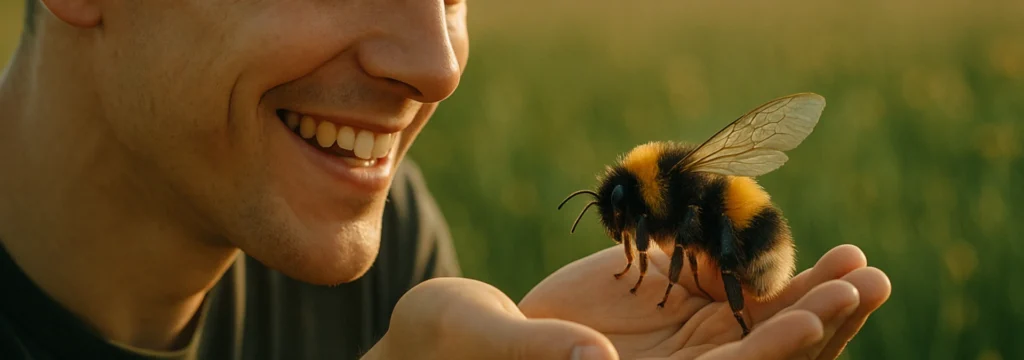
Bumblebees are far more than just the furry relatives of bees. They belong to the family of true bees (Apidae) and play a central role in the pollination of many plant species – both in agriculture and in natural ecosystems. Yet despite their enormous importance, many bumblebee species are threatened today. In this article you will learn everything worth knowing about bumblebees, their life cycle, their habitat and what you can do to protect them.
Bumblebees
Bumblebees are insects of the genus Bombus and belong to the family of colony-forming bees. Worldwide there are about 250 known bumblebee species, around 70 in Europe – about 40 of which live in Germany, Austria and Switzerland. They are characterized by their compact body shape, dense hair and the deep humming sound during flight.
Their robust appearance is deceptive: bumblebees are extremely efficient and specialized pollinators. Unlike honeybees they fly even at low temperatures and in poor weather. For this reason they are among the first insects in spring and among the last in late summer.
The life cycle of the bumblebee
The life cycle of a bumblebee begins in spring with a queen that has overwintered. Once temperatures rise above 10 °C, she leaves her wintering site and searches for a suitable nesting place – often abandoned mouse nests, earth holes or cavities in wood or buildings.
Once a nest is found, the queen lays the first eggs. These develop exclusively into workers, who later take over the care of the colony. In late summer the queen finally produces males and new queens that mate. Only the fertilized queens overwinter – the REST of the colony dies with the autumn.
The key phases:
- Spring: queen awakens from winter dormancy and establishes a nest.
- Early summer: first workers emerge and take over foraging tasks.
- Late summer: production of new queens and males.
- Autumn: old queen dies, new queens search for wintering sites.
The role of bumblebees in pollination
Bumblebees are indispensable pollinators for many plant species, as they perform tasks other insects cannot. Thanks to their ability for vibration pollination (also „buzz pollination“), they pollinate plants such as tomatoes, peppers and blueberries particularly efficiently – a task in which honeybees often fail for these species.
In agriculture, bumblebees are therefore intentionally used in greenhouses, for example to pollinate tomato plants. Their contribution to biodiversity and food security is immense – and yet their value is often undeRESTimated.
Advantages of bumblebee pollination:
- Effective pollination even in poor weather
- Higher fruit set and improved harvest quality
- Indispensable for certain crops
- Important for wild plants and the stability of ecosystems
Habitat and food
Bumblebees depend on species-rich flowering areas, traditional orchard meadows, meadows, hedgerows and foREST edges. They require a continuous supply of nectar and pollen plants throughout the season.
Particularly favored plants include:
- Clovers
- Meadow sage
- Viper’s bugloss
- Borage
- Bellflowers
- Phacelia (bee-friendly)
Gardens can also provide valuable refuges—provided they are designed in a nature-friendly way, free of pesticides and offer native flowering plants.
Threats and decline of bumblebee populations
Like many insect species, bumblebees are now under severe threat. Studies show that in recent decades many bumblebee species have declined dramatically or have become regionally extinct. The main causes are:
- Intensive agriculture: monocultures, pesticides and a lack of flower-rich areas
- Habitat loss: soil sealing, development and the decline of semi-natural areas
- Climate change: shifts in flowering times, extreme weather events
- Diseases and parasites: e.g., introduced species or insufficient genetic diversity
Particularly alarming is that even common species such as the buff-tailed bumblebee (Bombus terRESTris) are showing signs of decline. Some specialized bumblebee species have already disappeared from large parts of Central Europe.
What can be done for bumblebee conservation?
There are many ways you can actively support bumblebees – both in your own garden and at the municipal or agricultural level.
Tips for garden and balcony:
- Plant native, nectar-rich flowers
- Use no pesticides or chemical fertilizers
- Provide nesting opportunities, e.g. bumblebee boxes or undisturbed patches of bare ground
- Ensure continuous flowering from March to October
Tips for farmers and municipalities:
- Create flowering strips and field margin strips
- Preserve hedges, meadows and marginal biotopes
- Late or staggered mowing to protect nests
- Promote ecological farming
Identifying and observing bumblebees
The most common species in Central Europe can be distinguished with some practice:
- Buff-tailed bumblebee (Bombus terRESTris): black with yellow bands and a white tail
- Red-tailed bumblebee (Bombus lapidarius): black with a conspicuously red rear
- Common carder bee (Bombus pascuorum): light brown to orange, relatively dainty
- Garden bumblebee (Bombus hortorum): long-tongued, yellow-black-white striped
With a field guide or an app like „ObsIdentify“ or „iNaturalist“ you can easily take part in citizen science (Citizen Science) and document bumblebees.
Conclusion: Bumblebees need our help
Bumblebees are fascinating, peaceful, and indispensable insects for our environment. Without them many plants – and thus our food supply – would be at risk. Yet they are struggling to survive. Small measures in everyday life can have a significant impact on their protection.
By preserving their habitats, gardening in a nature-friendly way, and avoiding pesticides, we make a valuable contribution to biodiversity and to maintaining a healthy environment.