
Providing first aid is a skill everyone should master. Emergencies can occur at any time in daily life: a traffic accident, a fall at home, a circulatory collapse during sport, or an allergic shock in a RESTaurant. In such moments every minute counts. Knowing how to respond correctly can save lives and prevent serious long-term damage. Nevertheless, many people feel uncertain about administering first aid. This article explains why first aid is so important, what fundamentals everyone should know, and how to best prepare for emergencies.
Why is first aid so important?
Accidents and acute medical emergencies are part of life. In Germany alone thousands of situations occur daily in which first aid would be necessary. Unfortunately many people do not dare to intervene — out of fear of making a mistake. Doing nothing is always the worse option. Simple measures such as placing an emergency call, securing the accident site or the recovery position can be decisive. First aid bridges the time until professional rescue services arrive. Every minute without help can be life-threatening, especially in the case of cardiac arREST or severe respiratory distress.
Fundamentals of first aid
You do not need medical training to provide first aid. Everyone can and should know the basic measures. These include:
- Stay calm and assess the situation
In emergencies it is important to keep a clear head. First check the situation and get an overview without putting yourself in danger. - Secure the accident site
At traffic accidents this includes switching on hazard lights, putting on a high-visibility vest, setting up a warning triangle and securing the traffic. Self-protection is always the top priority. - Call emergency services
The European emergency number 112 should be known to everyone. Important information when calling: Who is calling? Where is the emergency located? What happened? How many injured persons are there? What kind of injuries or illnesses are present? Wait for any follow-up questions from the dispatch center. - Check consciousness and breathing
Speak to the affected person and check whether they respond. Check whether they are breathing normally. If there is no breathing, resuscitation measures (CPR) must be started immediately. - Recovery position
If the person is unconscious but breathing, they should be placed in the recovery position. This position keeps the airway clear and prevents vomit from entering the lungs. - Chest compressions and rescue breathing
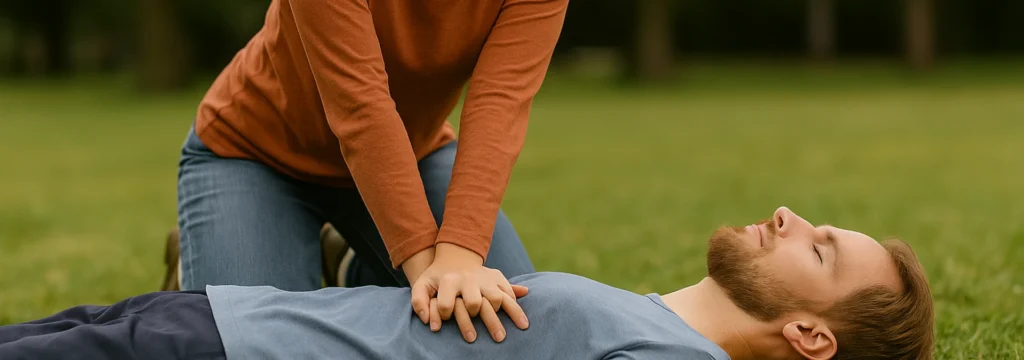
In respiratory or cardiac arrest, immediate resuscitation measures are critical. Chest compressions should be delivered at roughly 100 to 120 compressions per minute in the center of the chest, to a depth of about five to six centimeters. If someone is unsure about performing rescue breaths, they should at least perform chest compressions. - Control bleeding
Severe bleeding can be stopped by applying direct pressure to the wound. If possible, a pressure dressing should be applied. Small cuts and grazes should be disinfected if necessary. For use on the go, the Sonett hand disinfectant is suitable. - Shock position
If there are signs of shock – pale skin, cold sweat, rapid pulse – elevating the legs can help maintain circulation to vital organs.
Common emergencies and first-aid measures
There are many different situations requiring first aid. Here are some examples:
- Heart attack: Typical symptoms are severe chest pain, tightness, shortness of breath and anxiety. Affected persons should call emergency services immediately, be calmly positioned and, if possible, take any medication prescribed by a physician.
- Stroke: Signs are sudden paralysis, speech disturbances, visual disturbances or a drooping corner of the mouth. Call 112 immediately and keep the affected person calm and positioned.
- Asthma attacks or anaphylactic shock: Affected individuals should use their emergency medication (e.g., inhaler or adrenaline auto-injector). First-aid providers can assist.
- Burns: Cool minor burns with lukewarm water; do not treat larger burns with water, but cover them with a sterile dressing.
- Fractures: Immobilize and do not move the person until emergency services arrive.
Legal aspects of first aid
Many people are afraid of doing something wrong. Legally: a person who provides first aid cannot be held liable if they act to the best of their knowledge. Failure to render assistance, however, is a criminal offense. This means: everyone is obliged, within the limits of their capabilities, to provide help, at least by placing the emergency call. In addition, first responders are protected by the so-called „Good Samaritan“ principle, provided they do not act with gross negligence.
Refreshing first aid – why it is so important
Many people learn the basics of first aid during driving lessons, but this knowledge often fades quickly. Experts recommend taking a first-aid course at least every two to three years. There you can practice the techniques, learn new findings and increase your confidence in an emergency.
First-aid supplies for everyday use
It pays to be prepared. A first-aid kit is mandatory in the car, but it also makes sense to have a small first-aid supply at home or when doing sports. These include plasters, sterile compresses, gauze bandages, scissors, gloves and an emergency blanket. For allergy sufferers or chronically ill patients, specific emergency medications should always be accessible.
The psychological dimension of first aid
Alongside practical measures, psychological support also matters. For those affected it is often reassuring when someone is present who projects calm, offers comfort and gives them the sense of not being alone. Even simple hand-holding, calming words and announcing your actions („I’ll stay with you, help is on the way“) can make the difference.
First aid in special situations
Sometimes emergencies occur under challenging conditions – in the mountains, on the water or in extreme heat. The same basic rules apply, but rescuers must additionally pay attention to their own safety. Some measures differ for children or infants, for example during resuscitation. It is sensible to become familiar with these topics in an extended first-aid course.
Conclusion
Providing first aid is a fundamental skill that can save lives. Everyone is capable of taking simple but life-saving measures. Whether by securing an accident scene, placing an emergency call, using the recovery position or performing chest compressions – every action counts. It is important to overcome personal inhibition and take action. Those who regularly attend a first-aid course and familiarise themselves with the basics are more confident in an emergency and can support others. First aid is not only an obligation but an act of humanity that can make the decisive difference in critical moments.