
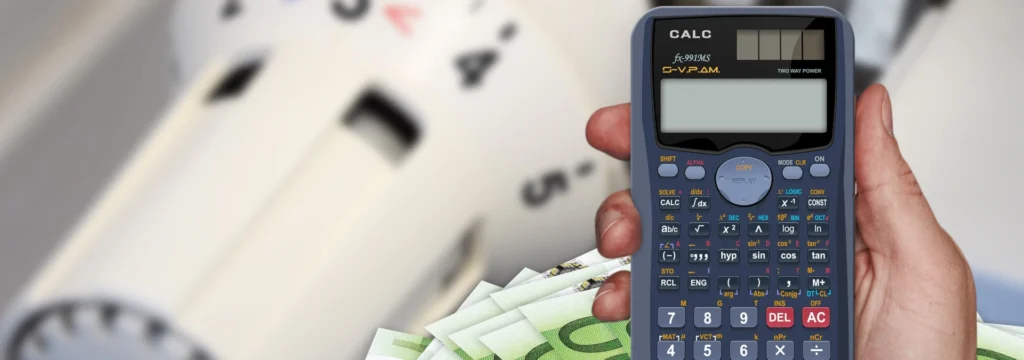
Guide to saving on heating costs
In times of rising energy prices, saving on heating costs is more important than ever. When oil and gas, electricity and coal were still cheaper, this topic was more or less irrelevant to many people. At present, hardly anyone can afford to waste a lot of energy when heating.
However, saving on heating costs is not only advisable from the perspective of the household budget. By minimizing energy costs you also protect the environment and the climate. In the following article you will learn which measures you can take in your apartment or owner-occupied home to save on heating costs.
Tip 1 to save on heating costs – ventilate properly and sensibly
Saving on heating costs is closely linked to ventilation. If you ventilate your apartment incorrectly, you will waste a lot of energy. Your living comfort will suffer as well. Comfort in your own four walls and saving energy costs do not have to be mutually exclusive; they are closely connected.
Ventilating in the cold season
Especially in the cold season you should definitely avoid ventilating for excessively long periods. Cross-ventilation is the best method to achieve a rapid air exchange. You should avoid prolonged ventilation with tilted windows. The time required to air out a room depends heavily on the season and the outdoor temperatures, or rather the temperature difference between the apartment and the outside air. At sub-zero temperatures, one to two minutes can be entirely sufficient to supply a room completely with fresh air.
Ventilating in spring and autumn
In spring and autumn, with mild outdoor temperatures, you can ventilate for longer. Here, 10–20 minutes is appropriate. In high summer you can of course ventilate for as long as you like. Make sure you have turned off the radiator when ventilating. If this is forgotten in winter you can waste a great deal of energy. Because as soon as the room temperature approaches zero degrees Celsius, the heating thermostat will attempt, with maximum heat flow, to prevent the heating from freezing. You should also ensure that curtains, blinds or roller shutters do not obstruct the airflow when ventilating. Regular ventilation is recommended not only because of heating costs; it also prevents mold growth. As a rule of thumb: it is better to ventilate frequently and briefly with cross-ventilation than to open the windows for long periods a few times a day. Note — with long ventilation durations your walls and furniture cool down. The energy required to reheat the apartment will increase.
Tip 2 to save on heating costs – operate radiators correctly
The room temperature can be controlled with the heating thermostat . Through deliberate use of the thermostat, heating costs can be significantly reduced. Most thermostats have a scale with numbers and symbols. The lowest setting is usually the snowflake. This is the heating’s frost protection function. On this setting the radiator is off at normal room temperature. Only when the room temperature approaches subzero does the valve open. Above that many thermostats also have the crescent moon. This marks the night setting.
The remaining numbers correspond to defined room temperatures. At setting 1 the radiator typically heats the room to 12 °C, at 2 to 16 °C, at 3 to 20 °C, at 4 to 24 °C and at 5 to 28 °C. On each setting the valve autonomously regulates the flow up and down so that the corresponding room temperature is maintained.
Many people make the mistake of turning the heating up as high as possible when the apartment is cold. However, this makes no sense. For example: at a room temperature of 5 °C the heating, whether set to 2 or 5, initially operates at full power until the target temperature is reached. Fully turning up the heating is therefore unnecessary. In addition, the thermostat is often forgotten and not turned down again, which wastes energy unnecessarily.
To achieve optimal efficiency, radiators should be bled regularly (at least once during the heating season). Since air transmits heat less effectively than water, otherwise energy is lost unused. Bleeding is not difficult, but can also be carried out by a heating engineer or caretaker if you do not feel confident doing it yourself.
Note: Radiators should not be covered by curtains or furniture. This creates heat accumulation and the room is not heated optimally. Drying damp clothing on radiators should also be avoided where possible.
Tip 3 to save heating costs – avoid draughts
Slow heat loss due to draughts is a common cause of high heating costs. This is particularly insidious because the affected spots are often not noticed at first glance. Draughts frequently occur at oversized door gaps. In particular, cold air enters under doors. This can be prevented by using a draught excluder, by adjusting the doors, or by structurally aligning the door threshold. For particularly large gaps, the entire door frame can also be fitted with sealing tape that is applied between the door and the frame. Draughts also occur at old or poorly closing windows. Here, adjustment or the use of sealing tapes can help. Old door and window seals should be replaced occasionally. Unnecessary draughts within the apartment should also be avoided. Thus, the doors of rooms that are not heated during the day should remain closed.
Tip 4 to save heating costs – better insulate the house
Heating energy is eventually lost again through the walls, ceilings and floors. In addition, a large portion of the heat escapes through the windows, even when they are closed. How long living spaces retain the heating heat also depends on the building’s insulation. Older buildings in particular, with thin walls and old single-pane windows, let heating heat escape faster than residents would like.
Carrying out insulation is therefore the ideal measure to save heating costs on a large scale without having to freeze. Façade insulation is the most common measure, but unfortunately also expensive. In the long term it is worthwhile, however. During a complete façade renovation it is even legally required to insulate the exterior walls.
Replacing old windows with modern multi-glazed windows can likewise save a great deal on heating costs. Particular attention should be paid to the insulating performance of the window frames. Those who cannot afford a full renovation should at least consider insulating the ceilings in older buildings. This is possible with comparatively little effort and in rooms with high ceilings there is no loss of living comfort. Since heat always rises, ceiling insulation is very effective. A low-cost insulation option is internal insulation using Styrofoam, mineral foam or wood. However, this should be carried out professionally, otherwise condensation and mold formation may occur.
Tip 5 to save heating costs – Have the heating system serviced or replaced
Owners of a private home should have their heating system serviced at regular intervals. A poorly adjusted heating system does not operate efficiently and consumes more fuel than necessary. In addition, a well-maintained heating system has a longer service life. The probability of malfunctions is reduced. Emissions are also lower with a well-maintained heating system. Maintenance of the heating system should be performed by a professional heating technician. Although maintenance has its cost, the expense is offset by fuel savings, extended service life and the reduction of failures.
In some cases it may also be appropriate to replace the entire heating stove, the gas boiler or at least the oil burner. This applies especially if the existing system is already many years old. New heating technology almost always operates more efficiently and with lower emissions.
Tip 6 to save heating costs – Compare prices
Whether you heat with oil, coal, wood or gas: you can save heating costs by paying attention to the choice of energy supplier and the timing of your order. For larger order volumes suppliers usually grant a quantity discount. You can also save on delivery costs by consolidating orders within a locality, for example with neighbors. In midsummer you can generally buy fuels at lower prices. But also watch for business-cycle related fluctuations. With the help of the internet, prices can be tracked on a day-to-day basis today.