
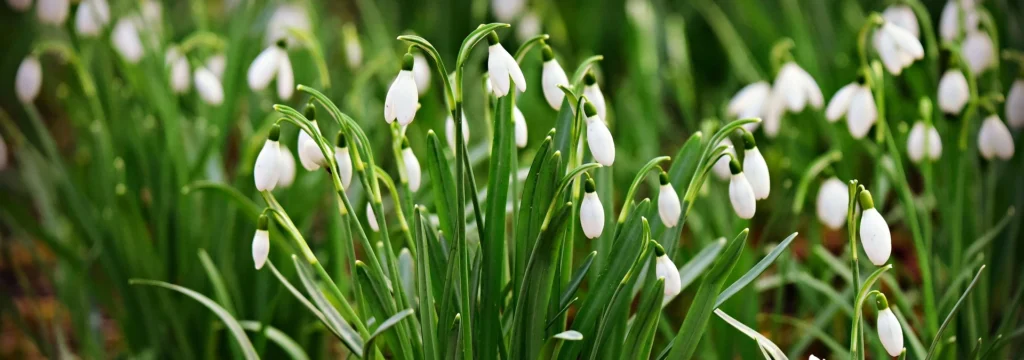
Snowdrops are delicate, white blossoms that herald spring. Few other plants embody the transition from winter to the warmer season as clearly. With their nodding, bell-shaped flowers they are among the first blooms to push through the ground after winter. But the flowers are far more than just attractive spring messengers – they have a fascinating history, distinct symbolism and ecological value.
What are snowdrops?
They belong to the Amaryllis family and are perennial, winter-hardy bulbous plants. There are about 20 different species worldwide, of which the Common Snowdrop (Galanthus nivalis) is the best known. The plants reach between 10 and 30 cm in height and are characterized by narrow, green leaves and nodding, white flowers that resemble small bells.
When and where do snowdrops bloom?
The flowering period begins, depending on the weather, as early as January or February and continues into March. They are particularly resilient and withstand even snow and frost. They prefer moist, nutrient-rich soils and grow in woodlands, gardens and parks. Particularly impressive are so-called snowdrop carpets, which are regarded as natural wonders in many regions.
Meaning and symbolism
The flowers represent hope, new beginnings and purity. In many cultures they are seen as a sign of spring and are associated with positive change. They symbolize:
- Hope and renewal: As the first flower to appear after winter, it represents victory over the cold and a new beginning.
- Purity and innocence: The white petals recall snow and are associated with purity.
- Mourning and farewell: In some regions they are considered cemetery flowers and stand for farewell and consolation.
Snowdrops in mythology and history
The legends surrounding the flowers are numerous. One well-known story states that it grew as the first flower on earth. When winter shared its white colour with the flowers, the snowdrop was the only one to accept the snow and thus symbolized the hope of spring.
In the Middle Ages it was regarded as a protective plant against evil spirits. Farmers planted it in gardens to safeguard home and farm from misfortune.
Ecological importance
They are an important food source for bees and other insects. Because they flower early in the year, they provide pollen and nectar at a time when many other plants have not yet bloomed. Wild bees in particular benefit from the flowers.
Since snowdrops often grow in near-natural woodlands, they are also an indicator of healthy ecosystems. Unfortunately, some species are threatened due to habitat loss and illegal collecting.
Schneeglöckchen pflanzen und pflegen
They are easy to care for and can be cultivated both in the garden and in pots.
- Standort: They prefer semi-shaded to shaded locations with moist, humus-rich soil.
- Pflanzzeit: The bulbs are planted in autumn (September to November) about 5–10 cm deep in the soil.
- Pflege: After flowering the leaves should not be cut off, as they store nutrients for the bulb. Snowdrops multiply by daughter bulbs and by seed on their own.
- Gießen und Düngen: In dry periods they should be watered moderately. A natural mulch protects the soil from drying out. As fertilizer we recommend the fertilizers from ARIES.
Vermehrung von Schneeglockchen
They propagate in two ways:
- Zwiebelteilung: The mother bulb forms small daughter bulbs that develop into new plants after a few years.
- Samenvermehrung: Snowdrops produce seeds that are dispersed by ants. This occurs through a natural phenomenon known as myrmecochory.
Giftigkeit
Snowdrops contain alkaloids that are toxic to humans and animals. The concentration is particularly high in the bulbs. Ingestion can cause nausea, vomiting and diarrhea. Therefore they should be planted out of reach of pets and small children.
Besondere Schneeglöckchen-Arten
In addition to the common snowdrop there are other fascinating species:
- Galanthus elwesii: Larger flowers than the common snowdrop, native to Southeastern Europe.
- Galanthus woronowii: Originates from the Caucasus and is distinguished by particularly bright green leaves.
- Galanthus plicatus: Has wavy leaves and a longer flowering period.
Schneeglöckchen in der Kultur
The flowers carry meaning not only in nature but also in art and literature. Poets and writers have often described the flower as a symbol of hope and new beginnings. Especially in the Victorian era, snowdrops were popular and regarded as a sign of hidden love.
In England there are so-called snowdrop festivals, where visitors can stroll through large meadows of snowdrops.
Sustainable practices
Because some species of snowdrop are threatened by wild collection, bulbs should only come from sustainable sources. Planting them in one’s garden supports bees and insects and contributes to the preservation of these particular plants.
Conclusion
Snowdrops are far more than just harbingers of spring. They stand for hope, renewal and the power of nature. Their ecological importance as an early food source for insects makes them a valuable part of the natural cycle. Whether in the garden, in the wild, or as a cultural symbol – snowdrops captivate with their beauty and resilience. Those who plant them can enjoy their early flowering again each year and welcome the first signs of spring.