
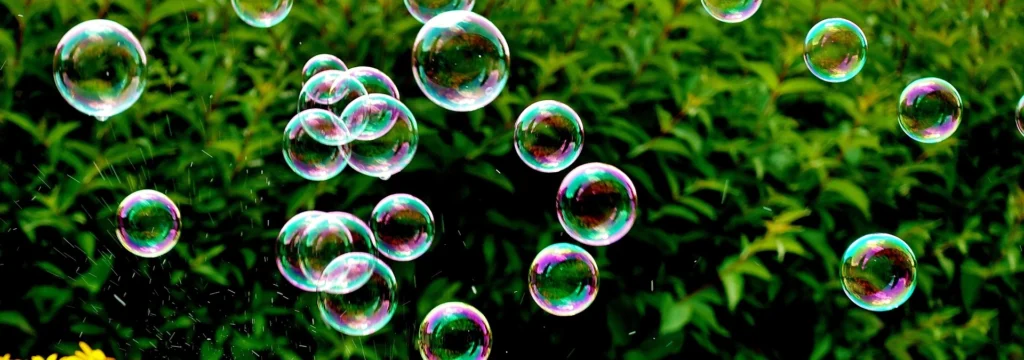
Soap bubbles delight people of all ages. Whether at children’s birthday parties, street festivals or simply in the garden on a sunny day – the iridescent dance of soap bubbles in the air brings a smile to every face. But soap bubbles are more than a popular toy: they are a fascinating physical phenomenon, a symbol of transience and an inspiration for science and art. In this article you will learn everything about the history, composition, the science and creative applications of soap bubbles.
History
The history of soap bubbles goes back a long way. Primitive forms of soap and possibly early soap bubbles were known in ancient Greece and Rome. In the Middle Ages soap was used primarily for personal hygiene, but in the 17th and 18th centuries the first depictions appeared of children playing with soap bubbles.
In Victorian England soap bubbles increasingly came to be seen as a symbol of life’s transience and found their way into art and literature. With the invention of industrial soap production in the 19th century, soap bubbles finally became a popular pastime for children – a role they have retained to this day.
The Soap Bubble
A soap bubble is a thin layer of liquid made of water and soap that forms a sphere and encloses air. The soap film consists of two layers of soap molecules surrounding a layer of water. This structure is highly stable and explains why they can be iridescent and long-lived.
Soap bubbles are perfect spheres because this shape provides the smallest surface area for a given volume – a principle commonly found in nature.
The Right Mixture
Not every soap solution is equally suitable for stable, iridescent soap bubbles. An ideal mixture contains:
- Water: Preferably use distilled water, as limescale or minerals can impair bubble formation.
- Soap or dish detergent: High-quality, preferably pure organic products
- Glycerin or sugar: These additives stabilize the soap film and extend the lifespan of the bubbles.
Basic recipe for soap bubble solution:
✔ 500 ml distilled water
✔ 50 ml dish detergent (we recommend the sustainable brands AlmaWin, Sodasan, Poliboy or Sonett)
✔ 1–2 tablespoons glycerin or sugar
The mixture should rest for several hours to allow the ingredients to combine properly.
Environmentally friendly soap bubbles
An increasing number of manufacturers are using biodegradable bubble solutions without microplastics or harmful additives. We recommend Sonett Bio Bubbles and the Sonett Bio Bubbles refill bottle.
Further tips for perfect soap bubbles
✔ Use distilled water where possible for a pure solution
✔ Let the bubble mixture rest for at least a few hours
✔ Blow in high humidity – dry air causes bubbles to pop faster
✔ Avoid strong sunlight and wind
✔ Use specialized bubble wands or rings for particularly large bubbles
Thicker bubble mixtures with a bit more glycerin or sugar are suitable for giant bubbles.
Physics and chemistry
Soap bubbles are an excellent example of how surface tension, light refraction and gravity interact.
Surface tension:
Water has a high surface tension, which is reduced by soap. This allows a flexible skin of water and soap to form that is stable enough to trap air.
Light interference:
The iridescent colours are created because light is reflected and refracted by the thin soap film. Depending on the film thickness and the angle of the light, different colours appear.
Gravity and evaporation:
While the bubble floats, gravity pulls the liquid downward. At the same time the water evaporates, which eventually causes the bubble to burst.
Creative applications of soap bubbles
Soap bubbles are not just playthings; they offer a range of creative applications:
Art:
Artists use soap bubbles as a medium for installations or painting techniques. With coloured bubble solution, bubbles can be burst onto paper to create colourful patterns.
Photography:
Soap bubbles provide spectacular motifs for creative photography – especially in combination with sunlight or unusual backgrounds.
Events and shows:
Professional bubble artists enchant audiences with giant bubbles, foam fountains and bubble sculptures.
Education:
In schools and kindergartens, soap bubbles are used to introduce children to physics, chemistry and the natural sciences in a playful way.
Soap bubbles pollinate flowers – Innovation in plant pollination
The pollination of flowers is a key component of ecological balance and agricultural production. Without the transfer of pollen by bees, bumblebees and other insects, many plants could not set fruit. In view of the global decline in insect populations, scientists and farmers are increasingly looking for alternative methods. One of these intriguing innovations is the pollination of flowers with soap bubbles.
Why new pollination methods are necessary
Bees, especially honeybees and wild bees, provide the lion’s share of pollination in nature and agriculture. However, pesticide use, monocultures, climate change and diseases are severely threatening their populations. In some regions of the world, for example parts of China, fruit trees already have to be pollinated manually.
This development makes one thing clear: if we want to continue to rely on secure and diverse food production, we need complementary or alternative pollination methods.
✔ Protect crops as natural pollinators decline
✔ Increase pollination efficiency under adverse weather conditions
✔ Ensure supply security for fruit, vegetables and nuts
How does pollination with soap bubbles work?
The idea of using soap bubbles for pollination sounds at first like science fiction. In practice, the method is surprisingly simple and elegant:
✔ Special soap bubbles are filled with a mixture of soapy solution and flower pollen.
✔ These bubbles are directed onto flowering shrubs and fruit trees or distributed by drones.
✔ When a bubble bursts on a flower, the pollen adheres to the flower’s stigma.
✔ The plant is pollinated — without bees, wind or manual labor.
This technique was developed in part by Japanese researchers, who demonstrated that soap bubbles can provide an extremely gentle, efficient and cost-effective method of pollination.
Conclusion: Soap bubbles – small wonders with big impact
Soap bubbles are a compelling example of how simple chemical and physical processes can produce striking effects. Whether as children’s play, an art form, a research object or a natural phenomenon — soap bubbles stimulate curiosity, imagination and enjoyment. Their lightness and transience remind us to appreciate the moment and to consciously notice the small wonders of everyday life.
With the right mixture, a little patience and a touch of creativity, you can create enchanting soap-bubble moments — whether in your own garden, at celebrations or as an inspiring project for young and old.