
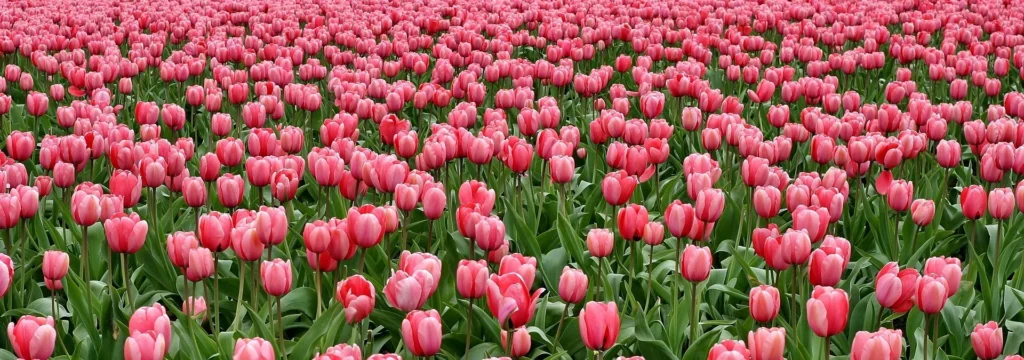
Tulips are among the best-known and most popular flowers in the world. With their vivid colors and elegant shapes they adorn gardens, windowsills and flowerbeds. The tulip is not only a symbol of spring but also a true masterpiece of nature. In this article you will learn everything worth knowing about tulips – from their history and the various varieties to care and planting tips.
History: From the Orient to Europe
The tulip originally hails from Central Asia, more precisely from the regions of present-day Uzbekistan and Turkmenistan. Here the flower was already appreciated by the Ottomans and cultivated in gardens as early as the 10th century. The bloom eventually attracted European attention in the 16th century. The name „tulip“ derives from the Turkish word „tülbend“, which means „turban“, because the flower’s shape resembles a turban.
They were brought to Europe by the Ottomans, and in the Netherlands they experienced a true flowering in the 17th century. The so-called „Tulip Mania“ led to tulip bulbs being traded at astronomical prices. Today the Netherlands are the center of tulip cultivation and export millions of tulip bulbs worldwide every year.
The different varieties
There are over 150 different species of tulips, which differ in shape, color and flowering time. The main groups can be divided into the following categories:
- Frühlings-Tulpen: These varieties bloom early in the year and are particularly hardy in winter. They are ideal for cultivation in temperate climate zones.
- Spätblühende Tulpen: These varieties open their flowers later in spring. They offer a beautiful display that prolongs the spring.
- Einzel- und doppelte Tulpen: Some tulip types have simple petals, while others feature particularly dense, double petals.
- Gefranste Tulpen: These varieties are distinguished by their delicate, fringed flower margins and are a real eye-catcher in any garden.
- Papagei-Tulpen: These unique ones have ruffled petals in vivid colors and are named after exotic parrots.
Planting tulips: Tips for the right location
To successfully plant tulips it is important to choose the right location. They prefer sunny to partially shaded spots. The soil should be well-draining to avoid waterlogging, since tulips are sensitive to excessive moisture. A loose, humus-rich soil promotes the growth and flowering of tulips.
When should they be planted?
Tulips are generally planted in autumn, ideally from September to November, before the ground freezes. The bulbs require a dormant period in the soil to produce strong blooms in spring. Plant the bulbs approximately 10 to 15 cm deep and maintain sufficient spacing between individual bulbs—about 10 to 15 cm.
Tulip care in the garden
Care is relatively straightforward, but requires a few important steps:
- Watering: Tulips need sufficient water during their growth phase. However, take care to avoid waterlogging, as this can lead to root rot. Even soil moisture is optimal.
- Fertilization: A balanced fertilizer helps support tulips during the flowering period. Use a specific flower fertilizer or an organic fertilizer that supplies the plants with the necessary nutrients. The flower fertilizer from Aries is recommended.
- Pruning after flowering: Once the flowers have wilted, the spent blooms should be removed. However, leave the foliage in place, as it continues to transport nutrients to the bulb that the plant needs for the next season. Cut back the foliage only once it has turned yellow.
- Winter protection: In particularly cold regions, it can be sensible to cover the tulip bulbs in winter with a layer of leaves or straw to protect them from frost.
The cultural significance of tulips
Tulips have played a significant role in many cultures. In the Ottoman Empire they were revered as a symbol of beauty and prosperity. In the Netherlands, where they became a national icon, they are also closely linked to economic history. During the Tulip Mania in the 17th century, tulip bulbs became a valuable currency, and their prices rose to absurd heights. Today they are not only a popular garden plant but also a symbol of spring and renewal.
Tulips also appear frequently in art. Renowned painters such as Jan Brueghel the Elder and Rembrandt painted tulips in their works, underscoring the deep cultural significance of these flowers.
The symbolic meaning of tulips
Tulips are sought not only for their beauty but also hold significant symbolic meaning. In many cultures they represent love, beauty and hope. Red tulips symbolize passionate love, while yellow ones stand for friendship and good fortune. White ones are regarded as a sign of purity and new beginnings.
Conclusion
Tulips are more than just pretty flowers. They are a symbol of spring, a cultural icon and an important component of many gardens and floral arrangements. With their variety of colors and forms they bring not only beauty to the garden but also joy and hope. If you plant them in your garden, you should consider the proper site and care conditions to experience their splendor in full bloom.
The flower has a rich history dating back to the 10th century and remains today an established element of garden culture worldwide. Whether you love tulips or have never planted one, now is the perfect time to familiarize yourself with these wonderful plants!