
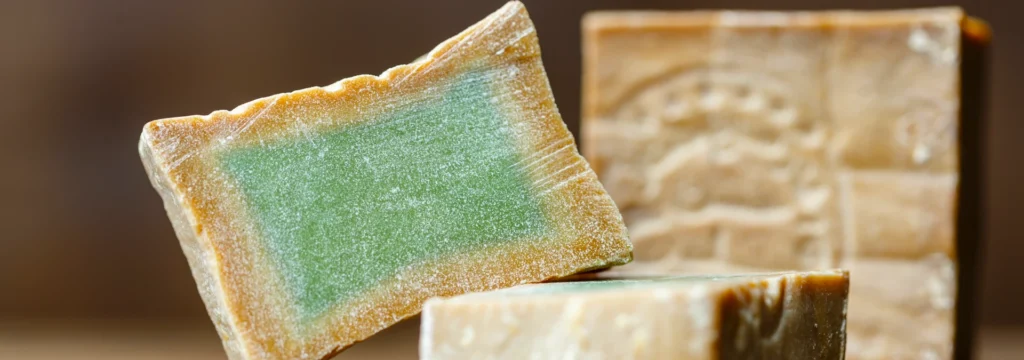
Versatile Aleppo Soap – History and Production
Soaps are a component of our daily lives. Sustainably produced natural soaps are becoming increasingly popular. You might ask yourself: What exactly is an Aleppo soap? The versatile Aleppo soap is produced in and around Aleppo and, of course, also outside of Aleppo. Aleppo soap is vegan and is made from olive and laurel (bay) oil. The laurel oil content varies between 4–40%. Aleppo soap is regarded as one of the oldest natural soaps in the world. There are soap recipes that date back to antiquity.
Origin of the Versatile Aleppo Soap
Aleppo soap is also known as “Syrian laurel soap.” However, it is of course produced outside Syria as well. It consists of olive oil with varying proportions of laurel oil. It is classified as a natural soap because it contains no additives such as colorants, stabilizers, or other synthetic substances. Aleppo soap has an earthy, natural scent. Soap makers are also referred to as soap masters. They have been producing natural soaps for many centuries (probably since the 8th century AD).
Discovery of the Versatile Aleppo Soap
Soap has existed for thousands of years. The earliest Aleppo soaps were already produced as early as 3,000 BC. Historians believe that the Sumerians in Iraq used a solution of ash and water to degrease wool. The Greeks and Egyptians also developed their own soap-making recipes. It is believed that the Crusades later spread the soap-making process from Syria to Europe. During the Middle Ages, various craftsmen developed their own soap recipes. These recipes remained strictly secret. Most of them consisted of ash mixed with animal fat. The large supplies of olive oil led people in Mediterranean countries to process plant oils into soap instead of animal fats. These finer soaps were therefore suitable for body care.
Versatile Aleppo Soap – the Oldest Natural Soap
Aleppo soap is considered the oldest natural soap in the world. Nevertheless, many reliable sources believe that the soap-making process originated in a region where Aleppo was an important industrial and trading city. Based on these sources, Aleppo soap may have been produced since the 8th century AD. Soap makers from the area around Aleppo in Syria discovered this recipe and have preserved this millennia-old expertise to this day. Fundamentally, soap production in Aleppo has changed little since then. The traditional natural soaps from Aleppo remove dirt and oil to thoroughly cleanse skin and hair. Natural essential oils have mild antibacterial properties that help in treating eczema, dry skin, and acne. The soap’s mild re-fatting effect is due to the laurel oil it contains. It is added only at the end of the saponification process so that it can fully develop its caring properties.
All-rounder Aleppo Soap – Traditional Production
In the traditional production of Aleppo soap, olive oil is heated in a large, floor-deep pot over an open flame at approx. 200 degrees Celsius. This process lasts up to three days. For saponification, water and soda are added in batches. After the saponification process is complete, laurel oil is added shortly before full salting out. Did you know? Laurel oil in Aleppo soap has a moisturizing and antibacterial effect. After boiling, the lye is poured off. Overnight the soap mass can cool and drain. In the next step the mixture is poured onto a smooth, foil-lined floor surface and smoothed. There the Aleppo soap hardens and dries for up to 40 hours. The hardened substance is then cut by hand into rectangular soap pieces. After cutting, the pieces are sealed with a traditional embossing stamp. This is followed by ventilated dry storage for six to nine months.
All-rounder Aleppo Soap then and now
Historical uses of Aleppo soap
The ancient Greeks and Romans already used Aleppo soap for body cleansing, skin care and wound healing. Primarily due to the included laurel oil, Aleppo soap has an antibacterial effect on the skin. Additionally, it has cleansing and moisturizing properties. From a medical perspective, the ingredients were used especially for scabies, lice infestation, paronychia, acne and eczema. They are also said to relieve insect bites and abrasions. Even then the soap was used to wash hair, including beards, and to remove dandruff.
All-rounder Aleppo Soap – popular uses today
Then as now. Aleppo soap is versatile and an all-rounder. For washing hands, for body care and also for hair and beard washing. As a sustainable cleaning agent, Aleppo natural soap is also well suited. As already mentioned, the ratio of olive oil to laurel oil varies. Fact: The higher the laurel oil content, the more expensive the production and the more valuable the soap. Natural Aleppo soaps retain their quality for years. CONCLUSION: You can use Aleppo soap for washing, cleaning household textiles, for tooth brushing or as shaving soap. When stored dry, the soap maintains its quality for several years.