
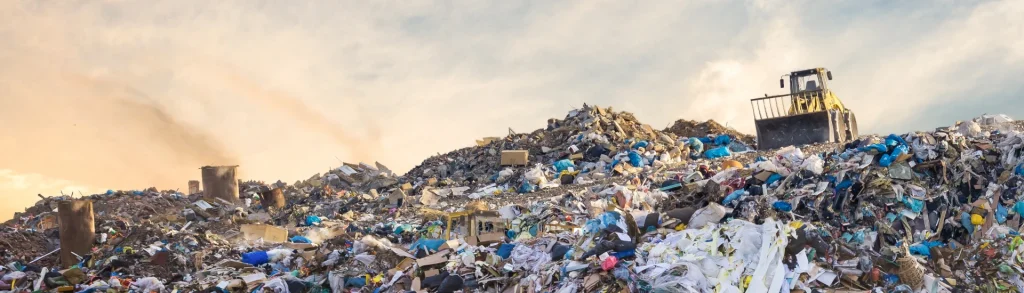
Avoid – recover – dispose: managing waste
Waste is one of the greatest problems facing humanity in modern times. We produce vast quantities of materials, gases and other residues that nature cannot process. But how did this come about and what can each of us do?
The world is choking on our waste
We have adopted a lifestyle in which we produce many substances that we can no longer—or only with great difficulty—reintroduce into natural cycles.
When you consider that all our raw materials come from nature, the problem appears paradoxical.
Why are we able to transform nature into plastic, aluminium, other metals, fuels, cars, houses and clothing? And why are we unable to „return“ these things in an environmentally compatible way when we no longer need them?
The answer seems simple at first and yet is very complex: we alter natural raw materials too much. We manipulate them repeatedly—chemically, mechanically, or in the case of nuclear power even under extreme force.
What remains are substances that have become worthless to us. They accumulate, become barely manageable and poison our planet.
Waste: nobody wants it, and everyone produces it
For simplicity’s sake and to keep the discussion close to the consumer, this article focuses on ordinary household waste — that is, the waste each of us produces in everyday life.
No matter how environmentally conscious or „eco“ we are, few can avoid waste: whether worn and damaged clothing, paper scraps, packaging (who can avoid that entirely), batteries, old electrical appliances, food residues, wastewater, CO₂, manure from intensive livestock farming, etc. The list is long!
And anyone who drives a car inevitably emits exhaust. The car itself becomes „waste“ at the latest after twenty to thirty years. In addition, the 4G transition is turning thousands of old and often still functional mobile phones and smartphones into unusable waste.
The history of household waste
Looking at our history, one quickly finds that mountains of waste are a problem of modern times.
Since industrialization, technological development, urbanization and the growth of the world population, the waste problem has been increasing rapidly.
In the past there were fewer people overall. There was less food and fewer consumer and luxury goods. People grew a large portion of their own food. They worked in agriculture and kept their own slaughter animals. Furthermore, supply routes to small communities and even larger towns were shorter. Consumption was more direct.
Preservation measures for long transports or storage routes, complex packaging, or chemical and technical manipulations were applied to food and consumer goods. When there was packaging, it consisted of paper or metals.
Still, two hundred years ago people bought in small regional markets, from producers or from a few large manufacturers.
The development of canned goods, the forerunners of today’s convenience foods, dates back to 1810.
By the end of the 19th century the range of packaged foods steadily increased. Supermarkets and the plastic craze, however, only really took off from the 1960s onward. Since then, waste generation in the private sector has steadily risen.
Waste volume and waste disposal today
To cope with the gigantic volumes of household waste there are various methods:
*Incineration
*Accumulation in landfills
*Return through recycling.
Germans produce around 13 million tonnes of household waste annually, or about 156 kilograms per capita. Including bulky waste it is 187 kilograms per capita and roughly 15.5 million tonnes in total.
The disposal or recycling of waste costs billions, which we partly pay as household waste fees or indirectly through product prices.
Is prevention the solution?
Preventing waste from arising in the first place is certainly one of the most effective ways to address the problem.
It took a very long time for the general public and industry to respond to the problem. It repeatedly required pressure from the governments of responsible states.
Regulations to reduce plastic bag use and the forthcoming bans on small plastic items are a positive development.
Environmentally minded people have been doing this for a long time: they avoid unnecessary packaging, prefer loose goods and always carry a cotton shopping bag.
Nevertheless – looking around in the supermarket, one still finds plastic packaging that is actually avoidable on fruit, vegetables, meat, sausage, etc.
In the dairy sector glass bottles enjoyed a brief revival in the late 1980s. However, they did not prevail. Only a handful of people are willing to buy the slightly more expensive yogurt or milk in glass.
Recycling is on the rise
Sweaters made from synthetic fiber have long been a reality. Alarmingly, 70 to 80 percent of our clothing today is already made entirely from synthetic fibers.
Although much more of this clothing could be produced from recycled fibers, that remains wishful thinking. Recycling is more expensive than producing new material.
We conscientiously take many materials separately to recycling centers and landfills today. Yet not all of these collected goods are actually recycled. Many are collected and separated only for the sake of collection.
Since the widespread introduction of biowaste bins, biological household waste has been recycled 100 percent.
Is there a way out of the waste problem?
Avoid – recover – dispose: the handling of waste
Researchers estimate the half-life of a PET bottle drifting in the sea at around 60 years. By then it will have been reduced to half its components by the action of water, sun and salts. It will not, however, completely dissolve. According to the current state of science, persistent microparticles will remain. In soil or under dry conditions the waste is even more stable.
Perhaps archaeologists will dig in five thousand years into the remnants of our civilization.
They will find strange deposits with thousands of stacked bicycles, nuclear waste repositories and the remains of our household waste beneath a thick layer of earth.
They may wonder whether these sites served a peculiar cult and which gods we worshipped: consumption, looking away, throwing things away and petrochemistry?
They might even find a plastic CD sleeve with a portrait of Michael Jackson and the inscription „Heal the world.“
At best these people will look into the face of a still-healing or healed world, in which smart researchers have found ways to transform the materials they invented back into their natural components.
Nature has an incredible capacity to regenerate and we do not know what research will have discovered in ten, twenty or a hundred years.
A serious rethinking has taken place at the latest since the onset of global climate change.
Improving cooperation between states, industry and scientific fields also gives reason for hope.
Bio-PET and televisions made from sugarcane husks?
GreenPE and other natural plastics are on the rise. The fact is that this area offers considerable potential.
Besides sugarcane and palm leaves, raw materials such as hemp and flax are promising candidates for environmentally compatible packaging, plastics and textile fibers.
The fact is that, given our current level of technology, we will very likely not be able to dispense with all problematic materials for a long time.
Even though many people remain ignorant, an overall positive development can be observed. In the end it also depends on customers and their purchasing decisions.
What can every individual do in everyday life? Avoid waste, eat less meat, wear eco-friendly clothing, use bamboo toothbrushes. These are the small things that every individual can start doing immediately.
Also of inteREST: Recognizing and avoiding microplastics