
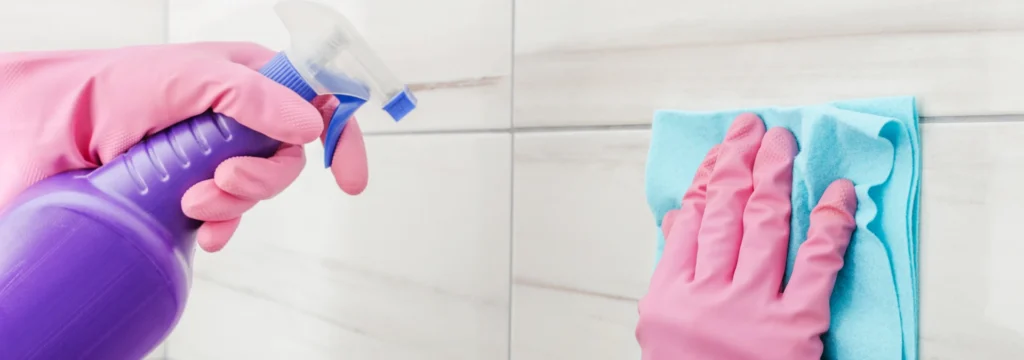
10 simple tips to RESTore your tiles and grout to like-new condition with basic household remedies
This problem is likely familiar to any of us. Even with thorough cleaning, dirt and grime accumulate on tiles and in grout over time.
Even if you regularly clean thoroughly, it is practically unavoidable that all kinds of dirt will deposit on your tiles and grout over time. For that reason you should sooner or later give your tiles a special treatment. Only in this way do you remove particularly stubborn dirt from the tile surfaces and from the tile grout.
Which grout and tiles are particularly affected?
Tiles in the kitchen, directly by the stove, and tiles in the bathroom—inside the shower enclosure or directly at the bathtub—are usually the most affected. Particularly stubborn fats and oils affect the kitchen tiles. In the bathroom it is typically soap residues and shampoo deposits that embed themselves in grout and tiles.
And it is not only that the appearance becomes increasingly unattractive. There is also a hygiene aspect to consider. Especially in the bathroom, mold formation and accumulation of bacteria can occur over time. For this reason it is advisable to give the tile grout in the kitchen and bathroom a little more attention from time to time.
Below we have compiled 10 tips for you. These tips will help you RESTore your kitchen and bathroom tiles and the tile grout to like-new condition using only household remedies. Hygiene will not be neglected.
We will start with five tips for cleaning tile grout, followed by five tips for cleaning the tiles themselves. Let’s get started.
Home remedy Tip 1. Soda as grout cleaner
A well-established and effective home remedy for cleaning tile grout is soda. Mixed with water it produces a very powerful alkaline solution. To prepare this strong mixture, 4 to 5 tablespoons of soda per 5 liters of water are recommended.
Specifically for cleaning the grout we recommend using an old toothbrush. Toothbrushes have proven particularly effective for cleaning grout. You should therefore have a toothbrush on hand in any case. We will refer back to this very useful tool repeatedly in the other tips.
After you have mixed the soda and water, brush the soda-water mixture into the grout and let it work for about 15 to 30 minutes. The mixture then has enough time to penetrate deeper into the grout.
Then rinse the grout with clear water and dry the grout with a clean cloth.
Home Remedy Tip 2. Vinegar Essence for Cleaning Silicone Seals
When working with silicone seals, special care is required. Because silicone seals are very soft, you can damage them very quickly.
For silicone seals you should use a vinegar essence diluted somewhat with water. Dip a cloth in the vinegar essence and then run it along the joints you want to clean. For stubborn soiling you can also use undiluted vinegar essence. First test on a spot that is not easily visible to check whether the joint becomes as clean as you expect.
Repeat the process several times if necessary until you achieve the desired result.
It is also important to note that vinegar essence is not suitable for conventional tile grout. The vinegar essence can attack the grout and make it porous.
For heavy soiling or severe mold infestation, however, we recommend replacing the joints. That is not difficult, restores a good appearance and is, of course, much more hygienic.
Home Remedy Tip 3. Toothpaste for Cleaning Joints
Even good old toothpaste has proven effective for cleaning joints. A product you almost certainly have in your household. As a small bonus, it leaves tile joints with a pleasant scent.
Simply apply the toothpaste to a toothbrush and brush it into the joints to be cleaned. We recommend letting it act for about 10 minutes. Then rinse the joints with clear water. Finally dry the joints with a clean cloth.
Home Remedy Tip 4. Baking Powder for Cleaning Joints
The next and also very effective cleaning agent to make your joints shine again is baking powder. By mixing baking powder and water you obtain a paste that will thoroughly clean your joints. This mixture is particularly effective on greyed or yellowed tile joints.
We recommend a mixing ratio of one part baking powder to four parts water. Take a small bowl and add one sachet of baking powder. Most sachets contain about 15 to 16 grams of baking powder. Then add about 60 ml of water and mix well.
You can then brush the resulting paste into the dirty joints. Do not be sparing with the paste; distribute it generously into the joints.
Leave it to act for 45 to 60 minutes. This time is necessary for the baking powder paste to develop its full effect.
Then rinse off the paste with plenty of clear water and dry the joints again with a clean cloth.
Home remedy Tip 5. Baking soda for cleaning grout
Now we also have baking soda on our list of recommendations. It may not be present in every household, but it is easy to obtain, very effective and acts quickly.
Put about 3 tablespoons of baking soda and 1 tablespoon of water into a bowl. Then mix them together and a crumbly paste will form. Fill this paste into the grout lines, ideally so that the grout is completely covered by the paste. Note that this method works best on flat tiles (for example floor tiles). Let it act for about 1 to 3 minutes. Then scrub the grout with a slightly dampened toothbrush.
The special feature of this method is that it is really extremely fast and effective.
Home remedy Tip 6. Baking-powder–vinegar mixture for cleaning tiles
The baking-powder–vinegar mixture as a tile cleaner is particularly suitable for cleaning kitchen tiles that are heavily soiled with oil or grease.
Take a small bowl again and put the contents of one sachet of baking powder into the bowl. Then take about three to four times that amount of vinegar and pour it into the bowl.
Now soak a cloth with this mixture and spread it generously over the tiles to be cleaned. Let the baking-powder–vinegar mixture act for approximately 15 to 30 minutes. Afterwards rub the tiles, and if necessary rinse the tiles with clear water and then dry them.
Home remedy Tip 7. Baking powder as a tile cleaner
Here again baking powder comes into play, this time as a tile cleaner. The difference from cleaning grout lies in the mixing ratio.
Put half a sachet of baking powder (approx. 7 to 8 grams) into a bowl. Then pour about 300 ml of water into the bowl and stir well. Let the mixture stand for 3 to 4 minutes.
Then dip a kitchen sponge into the solution and clean your tiles as usual. Because baking powder has a very strong cleaning effect, your tiles should shine again after cleaning.
Home remedy Tip 8. Vinegar for cleaning tiles
You can also use vinegar to clean your tiles. Simply put some vinegar (undiluted) on a household sponge and go over the tiles to be cleaned. Let it act briefly, then rinse the sponge with clear water and wipe the tiles clean. Finally dry the tiles with a clean cloth.
Home remedy Tip 9. Dish soap or rinse aid for cleaning tiles
Dishwashing detergent or rinse aid is also a very effective agent for cleaning tiles and is likely already available in your household. Dishwashing detergent is particularly suitable for removing grease deposits from tiles.
Fill a bucket halfway with warm water and add a few drops of dishwashing detergent or rinse aid. Now wipe your tiles with the lukewarm mixture of water and dishwashing detergent or rinse aid. Afterwards you can simply let the tiles air-dry or dry them with a clean cloth.
Home remedy tip 10. Orange peels for cleaning tiles
Our final tip for you is orange peels. This concerns only the peel, not the flesh! So peel an orange and collect the peel. Using the inner side of the peel, rub it over the tiles. For stubborn stains, work over them several times. Rinse the tiles with clear water to remove any residue from the orange peels and then dry the tiles with a clean cloth.
This method is mainly suited for cleaning smaller areas and for stains and stubborn dirt on the tile.
We have now presented ten home-remedy tips for cleaning tiles and grout. We wish you success trying them out.