
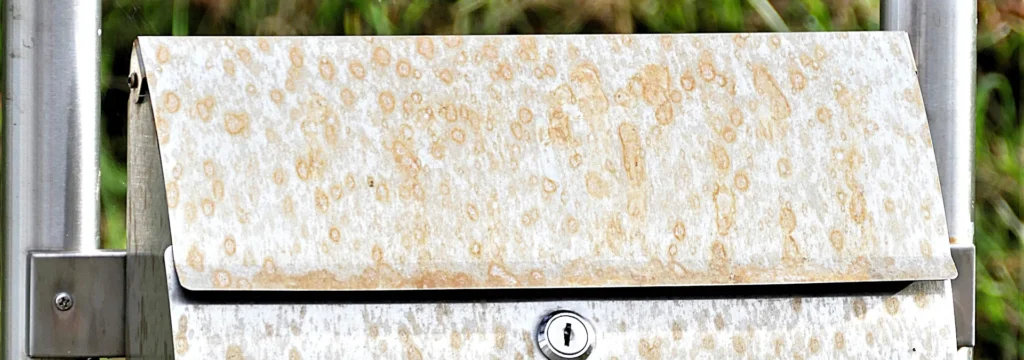
Remove rust with simple household remedies. Rust forms on ferrous metals that are exposed to air and/or acids. It can be removed with simple household remedies, although not always completely.
The most reliable household remedies to remove rust are:
- Citric acid
- Buttermilk
- Acetic acid and cooking oil
- Baking powder and baking soda
- Cola
- Steel wool
Surprisingly but true: although acid corrosion causes rust, acids such as citric acid can also dissolve rust. Commercial rust converters and removers mostly contain phosphoric acid.
What is rust?
Rust is a corrosion product. It forms from iron or rusting steel through oxidation. For this, oxygen and water must be present at the same time. Note: metals are therefore most likely to rust in humid air. Unlike other oxide layers on chromium, zinc or aluminium, porous rust does not protect against further degradation. Rusting iron metals can corrode through completely over time. Therefore it is important that you protect them with appropriate coatings and thereby stop an ongoing rust process. What you should know: important for removing rust is the fact that it forms loose, weakly bonded structures that you can remove relatively easily. As iron atoms bond with oxygen, they become heavier and larger. Rusting objects therefore increase slightly in weight and dimensions. The expansion of the molecular clusters generates stresses that can sometimes cause a rust layer to flake off.
Now we will look at how rust can be removed with household remedies.
Removing rust stains from garments
How does rust get onto clothing? Sometimes you find rust on your clothes from rusting buttons or zippers. Citric acid is a suitable household remedy here. It is in any case suitable for superficial rust damage. You cannot clean a rusting garden chair with it. Note: if you use lemon juice to remove rust from clothing, you must act relatively quickly. Why? Because otherwise the rust will fix itself. The application on garments is very simple: you squeeze a lemon. Or you use commercially available lemon juice, which you mix with warm water. The mixing ratio is about 1:1. Then dab this mixture onto the stain. Wait a few minutes and then put the textile in the wash.
Please note: lemon juice can act aggressively on certain very delicate textiles such as silk or nylon! A permanent discoloration could occur. In that case use buttermilk, which also contains a weak acid. Buttermilk does not attack delicate materials. You need to soak the garment in the buttermilk (approx. 1 hour). Afterwards the rust can be brushed out. Of course you should then wash this garment as well.
How do you remove rust from a metallic object?
There are several options for removing rust from metallic objects:
Rust removal with vinegar-cooking oil mixture
- Vinegar-cooking oil mixture: Mix vinegar and cooking oil in a 1:1 ratio. Apply this mixture thickly to the rust spots with a brush. Depending on the degree of corrosion, let the mixture act for one to several hours. Afterwards, wipe the rusted areas off with a cloth. If the rust is heavy, a wire brush or an old toothbrush will help.
Rust removal with baking powder–baking soda mixture
- Baking powder–baking soda mixture: Here too, mix in a 1:1 ratio. Moisten the mixture with a little water until a thick paste forms. Apply this to the rust with a sponge and again let it act for one to several hours depending on the extent of the rust; it can also be 24 hours. The paste is relatively gentle but slow. Therefore this cleaning method is particularly suitable for sensitive materials such as stone tiles. Clothing can also be treated with it.
Removing rust with Cola
Cola: For this home remedy, simply rub Cola onto the rust stains with a sponge or a soft cloth; the stains may loosen as a result. The method is not entirely risk-free, because Cola is corrosive. Sensitive materials could be damaged. Therefore test the application first on an inconspicuous area of the object.
Removing rust with steel wool
Steel wool: Steel wool proves very effective against rust. It can bring a rusted garden chair back to a shine. For delicate items such as jewelry or cutlery, however, the method is inappropriate. Moisten the steel wool with a little water, then proceed with intensive manual work. Scrub the garden chair or a rusted shovel vigorously. The loosened rust will drip off as a reddish-brown liquid. Wipe it off in the meantime. It’s best to lay a tarpaulin underneath. Otherwise rust stains will remain on the surface. They should instead be absorbed by the cloth.
How effective are household remedies against rust?
Home remedies for rust are not very strong, but they are sufficient for moderate rust stains. Sometimes your patience is required. In some cases you will need to repeat your cleaning attempts. A rusted metal object can be cleaned most efficiently with steel wool. The home remedies citric acid, buttermilk, baking soda, vinegar, baking powder and cooking oil have the invaluable advantage of being entirely environmentally friendly, since they are fully biodegradable. If the home remedies are not sufficient, you will have to resort to more extensive sanding of the rust and/or to chemical rust removers and converters based on phosphoric acid. Observe the instructions for use, which also contain provisions for the environmentally sound disposal of residues.