
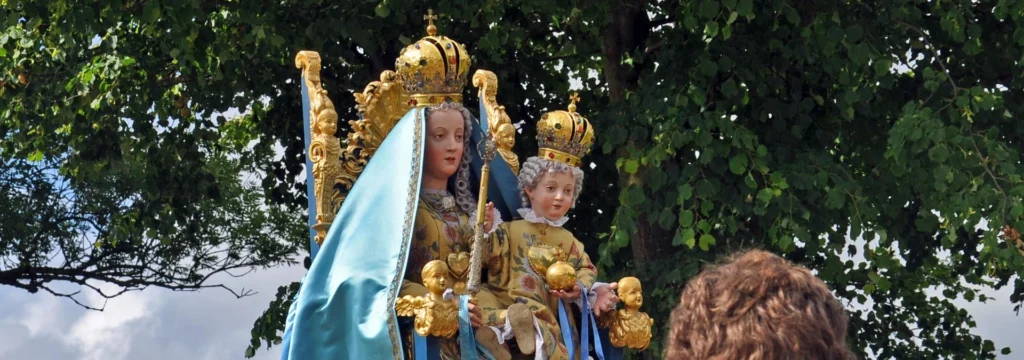
Corpus Christi is one of the most important feasts in the liturgical year of the Roman Catholic Church. It is celebrated every year on the second Thursday after Pentecost and places the presence of Jesus Christ in the Eucharist at the center. Corpus Christi is particularly known for its festive processions with elaborately decorated altars, flower carpets and the monstrance in which the Blessed Sacrament – the consecrated host – is carried through the streets. In this article you will learn about the significance, origin, customs and contemporary relevance of Corpus Christi – clearly, historically grounded and SEO-optimized.
Corpus Christi
Corpus Christi is a Catholic solemnity that celebrates the bodily presence of Jesus Christ in the sacrament of the Eucharist. The name “Fronleichnam” comes from Middle High German: “vron” means “Lord” and “licham” means “body”, i.e. “Body of the Lord”. The official Latin title is “Sollemnitas Sanctissimi Corporis et Sanguinis Christi” – “Solemnity of the Most Holy Body and Blood of Christ.”
The focus of the feast is the belief that Jesus in the consecrated host is not merely present symbolically but is really and truly present. Corpus Christi is therefore a feast of faith and of public veneration of this central mystery of faith.
When is Corpus Christi?
Corpus Christi is a movable feast that is always observed on the Thursday after Trinity Sunday (Trinity). That corresponds to the second Thursday after Pentecost – therefore at the earliest on May 21 and at the latest on June 24.
Examples:
- Corpus Christi 2025: Thursday, 19 June 2025
- Corpus Christi 2026: Thursday, 4 June 2026
The choice of Thursday is intentional: it is closely connected to Maundy Thursday, on which Jesus celebrated the Last Supper and instituted the sacrament of the Eucharist.
Origin and History
The origins of the Feast of Corpus Christi date back to the 13th century. A central role was played by the Augustinian nun Juliana of Liège, who experienced several visions in which she was called to introduce a feast in honor of the Eucharist. She was supported by church dignitaries, notably the then archdeacon Jakob Pantaleon of Troyes, who later served as Pope Urban IV.
In the year 1264 Pope Urban IV officially introduced the Feast of Corpus Christi for the entire Catholic Church with the bull Transiturus de hoc mundo. Particularly formative for the public perception of the feast was the Miracle of Bolsena: A consecrated host is said to have begun to bleed during Mass – a strong sign of the real presence of Christ.
From the late Middle Ages the Corpus Christi procession developed.
Traditions and Customs
The heart of the Feast of Corpus Christi is the procession, in which the consecrated host is carried in a monstrance under a so-called „Himmel“ (a canopy) through the streets. The route usually leads to four altars where Gospel readings are proclaimed and intercessions are offered.
Typical elements of the Corpus Christi procession:
- Monstrance: Displays the host and symbolizes the presence of Christ.
- Flower carpets: Elaborate patterns of petals and leaves laid along the procession route.
- Children scattering flowers: Often in communion attire.
- Church music: Brass bands or choirs accompany the procession.
- Banners and flags: Associations and parish communities carry their emblems.
In rural areas Corpus Christi processions are often closely linked to regional customs. Houses along the route are decorated, windows adorned or altars lovingly arranged.
Corpus Christi as a public holiday
Corpus Christi is a public holiday in several German federal states, including:
- Bavaria
- Baden-Württemberg
- Hesse
- North Rhine-Westphalia
- Rhineland-Palatinate
- Saarland
Corpus Christi is also observed as a holiday in parts of Austria, Switzerland, Luxembourg, Poland and South Tyrol. In other countries there may be Masses, but no statutory provisions for time off work.
Significance today
In an increasingly secular society the question arises: Does Corpus Christi still matter today? The answer is a clear yes – both spiritually and culturally:
- Spiritual: Fronleichnam is a public profession of the Christian faith and recalls the central importance of the Eucharist in church life.
- Communal: The feast brings people together — in building the altars, in singing, praying or celebrating after the procession.
- Cultural: Many customs surrounding Fronleichnam are deeply rooted in regional identity and contribute to the preservation of cultural heritage.
Even those who are distant from faith experience Fronleichnam as an impressive event.
Fronleichnam in ecumenism
As Fronleichnam is a specifically Catholic feast, it is not celebrated in Protestant churches. Nevertheless, in some regions there are ecumenical approaches, for example through joint prayers or devotions. Especially in times of societal challenges, the feast offers an opportunity for dialogue and reflection on shared values.
Fronleichnam in art and literature
Over the centuries Fronleichnam has also played an important role in art. Numerous paintings, songs and literary texts are devoted to the Eucharist and the procession:
- Ancient church hymns such as „Lauda Sion“ originate from Thomas Aquinas and were composed specifically for Fronleichnam.
- In baroque painting there are numerous depictions of Fronleichnam processions, miracles of the host and scenes of adoration.
Such depictions reflect the veneration of the Blessed Sacrament across different eras and underscore the significance of the feast beyond the church setting.
Tips for participating in Fronleichnam
Anyone who wants to take part in a Fronleichnam procession should note the following:
- Advance information: Dates and routes are usually published via parish newsletters or parish websites.
- Weather-appropriate clothing: The processions take place outdoors.
- Respectful conduct: Even as a spectator you should remain quiet and behave respectfully.
- Participation possible: Non-Catholics are also welcome.
Especially for families with children, participating in Fronleichnam can be a pleasant way to actively experience faith and culture.
Conclusion: Corpus Christi as a visible expression of faith
Corpus Christi is more than just a public holiday on the calendar. It is a solemnity that publicly affirms the belief in Jesus‘ presence in the Eucharist in a striking manner. The combination of community, art and custom makes this day one of the major feasts in the Catholic liturgical year.
Whether as a believing Christian or an observer – Corpus Christi offers a valuable opportunity for reflection, for community, and for engagement with a tradition that has retained its significance in the present.