
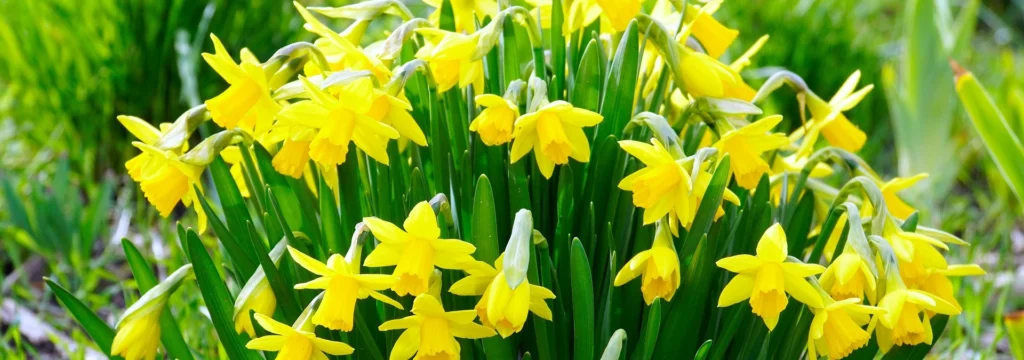
Daffodils (Narcissus) are among the most popular spring flowers and can be found in many gardens and natural landscapes. With their bright yellow, white or orange flowers they add color and life to spring and are regarded as true harbingers of the season. In this article you will find everything worth knowing about daffodils – from their origin and significance to care instructions and possible uses. Explore the world of these charming flowers and discover how they can enhance your home and garden.
Origin
The daffodil belongs to the genus Narcissus and is a plant in the family of Amaryllidaceae. It originally comes from southern Europe and North Africa, where it is primarily native to Mediterranean regions. Today it is widespread in many parts of the world and enjoys great popularity. It is particularly known for its use as a spring flower that traditionally blooms around Easter – hence the name „daffodil“.
Most daffodil species are perennial and form bulbs that are planted in autumn. In spring they then produce vigorous stems at the ends of which the characteristic flowers appear. Daffodils are not only attractive to look at but are also relatively low-maintenance and provide an effective way to give a garden or balcony a fresh, lively atmosphere.
Symbolism and meaning of daffodils
Daffodils are known not only for their beauty but also for their deeper symbolic meaning. They represent spring, renewal and hope – themes closely linked to the season. In many cultures the daffodil is seen as a symbol of the end of winter and the beginning of a new cycle. In Christian symbolism daffodils also have a place: they represent life that blooms after death and stand for resurrection and hope.
In the language of flowers the daffodil is regarded as a symbol of „caution“ and „awareness“, reflecting the significance of early spring blooms. The vivid colors of the flowers recall the first rays of sun after the long winter and convey a sense of optimism and vitality.
The different species and varieties
There is a wide range of daffodil species that differ in flower shape, color and size. Some of the best-known and most popular varieties are:
- Narcissus pseudonarcissus (Wild daffodil): This species is the classic wild-growing daffodil, found with its simple, golden-yellow flowers in many gardens and meadows.
- Narcissus ‚Tete-à-Tete‘: This compact cultivar is particularly popular for pots and balcony gardens. The small, bright yellow flowers appear in dense clusters and provide a lively display.
- Narcissus ‚Thalia‘: This cultivar is distinguished by its snow-white flowers, which have an elegant, almost delicate appearance. It is well suited for formal gardens and flower beds.
- Narcissus ‚Jetfire‘: This daffodil features a striking combination of orange trumpets and yellow petals. It is one of the more conspicuous varieties and adds color and energy to the garden.
- Narcissus ‚Carlton‘: This cultivar is characterized by its large, golden-yellow flowers with a broad, rounded trumpet. It is a classic spring plant and particularly robust.
Care and cultivation of daffodils
Daffodils are relatively low-maintenance but require some basic care measures to thrive and present well in spring. Here are some tips to care for your daffodils properly:
- Location: Daffodils prefer a sunny to partly shaded site. Choose a spot where they receive sufficient light to grow vigorously and produce many flowers. A slightly sandy or loamy soil that is well-draining is ideal.
- Planting time: The best times to plant daffodils are in autumn, when the bulbs are set into the ground. Bulbs should be planted about 10 to 15 cm deep, with spacing between bulbs depending on the variety at roughly 10 to 20 cm.
- Water and nutrients: Daffodils are relatively undemanding regarding water and nutrients. During the growing period it is important to water regularly, especially in dry spells, but avoid waterlogging. In spring it can also make sense to feed the plants with a specialized bulb fertilizer. The bulb fertilizer from ARIES is well suited for this.
- After-flowering care: After the flowers have faded, the spent stems should be removed so as not to weaken the plant unnecessarily. However, leave the foliage in place until it withers, as it returns important nutrients to the bulb. Once the foliage has died back, the bulbs can be lifted from the ground if you wish to transplant or propagate the daffodils.
- Overwintering: Because daffodils are hardy, in most regions they do not require special winter protection. The bulbs can remain in the ground and will sprout again the following year.
Uses of daffodils
Daffodils are not only an asset to the garden but also suitable for decorative use. They work well as cut flowers and bring a touch of spring to any home. A fresh daffodil bouquet in a vase creates a cheerful atmosphere and serves as an attractive focal point.
In addition, daffodils can be combined as companion plants with other spring flowers such as tulips, hyacinths or crocuses in beds and borders. Their bright colors harmonize wonderfully with other spring bloomers and create a fresh, colorful overall appearance.
Conclusion
Daffodils are not only a delightful decorative feature for gardens and balcony planters, but also a symbol of spring and the renewal of life. With their colorful blooms they bring joy and optimism to the cold season. Their care is relatively straightforward, and they are available in numerous varieties, so every gardening enthusiast can find a suitable daffodil. Whether as cut flowers, in beds or as ornamental plants – daffodils are a real eye-catcher and an indispensable part of spring.