
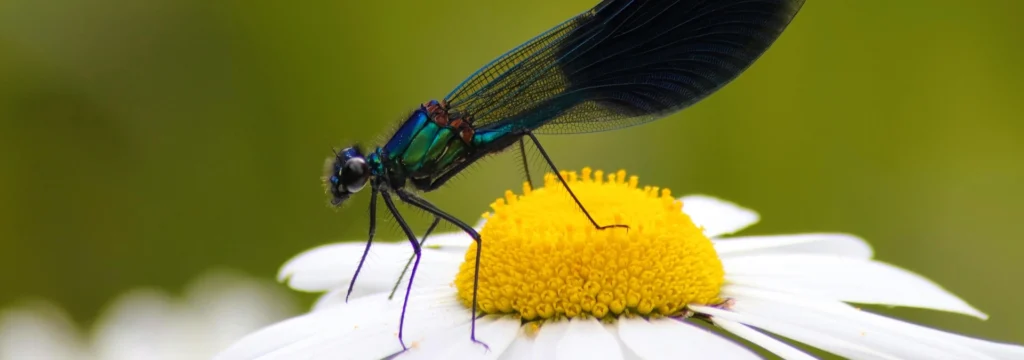
Dragonflies are among the oldest insect species on Earth and fascinate with their unique flight mechanics, iridescent colors and their important role in the ecosystem. Worldwide there are over 6,000 known dragonfly species, about 80 of which occur in Germany. Whether at garden ponds, on wet meadows or along riverbanks – they are true indicators of intact nature. In this article you will learn everything worth knowing about dragonflies: their characteristics, way of life, species diversity, ecological importance and tips for protecting these impressive insects.
Dragonflies
They are insects of the order Odonata, which can be divided into two groups:
- Dragonflies (Anisoptera): robust body, wings held widely spread when at rest
- Damselflies (Zygoptera): slender body, wings usually folded together above the body when at rest
Typical features are their large compound eyes, two pairs of wings, an elongated abdomen and their excellent flight capability. They can fly in all directions, even backwards – a feat mastered by very few other animals.
Masters of flight
They are among the best fliers among insects. Their wings are movable independently of each other, which gives them extreme agility and control. They reach flight speeds of up to 50 km/h and can remain aloft for long periods, adopt so-called „hovering“ positions or change direction in an instant.
This flight technique makes dragonflies extremely successful predators: they catch mosquitoes, flies and other insects in flight – often with a success rate of over 90 %.
Habitat
Dragonflies are closely tied to bodies of water, as they lay their eggs in or on aquatic plants and spend their larval stage exclusively in the water. Habitats include:
- Ponds, lakes and pools
- Streams, rivers and bogs
- Floodplains and wet meadows
- Garden and natural ponds
High water quality is important for the survival of dragonfly larvae. That is why dragonflies are also considered Bio Indicators – their presence indicates a healthy environment.
The life cycle
They undergo a so-called incomplete metamorphosis – that is, they develop from the egg through several larval stages directly into the adult dragonfly (Imago), without a pupal stage as in butterflies.
- Egg laying: Females lay their eggs in or by the water – depending on the species directly onto aquatic plants or into open water.
- Larvae (nymph): The larva lives for several months to years in the water, is predatory and feeds on small aquatic animals.
- Emergence: On a warm day the larva climbs out of the water, the back skin splits open, and the finished dragonfly emerges.
- Imago (adult dragonfly): The lifespan as an adult dragonfly usually lasts only a few weeks, during which it must reproduce.
Species in Germany
In Germany are about 80 dragonflies Species native. Some here:
- Emperor dragonfly (Anax imperator): One of the largest native species with vivid blue colouring.
- Four-spotted chaser (Libellula quadrimaculata): Easily recognised by the four dark spots on its wings.
- Blue-green hawker (Aeshna cyanea): Notable for its shimmering, mosaic-like colour pattern.
- Common blue damselfly (Coenagrion puella): A frequent small damselfly with a delicate pale-blue body.
- Banded demoiselle (Calopteryx splendens): Metallic, glossy wings; prefers slow-flowing water.
Many of these species are protected, as their populations are threatened by habitat loss and pollution.
Why they are important
They are important components of the ecological balance. They fulfil several essential functions:
- Predators in water and air: Dragonfly larvae regulate populations of aquatic organisms. Adult dragonflies keep mosquitoes and flies in check.
- Food for other animals: Birds, frogs and fish feed on dragonflies – they are part of complex food chains.
- Indicator species: Their presence indicates clean, stable habitats. When dragonflies disappear, that is often a warning sign.
Through their life cycle dragonflies connect two habitats: water and air – they are thus a symbol of change, adaptation and biodiversity.
Dragonflies and Climate Change
They are highly dependent on the water balance and temperature. Their distribution is changing as a result of climate change:
- Some southern species are expanding northwards.
- Native species disappear locally due to drought or water pollution.
- Extreme weather events such as heat waves or floods endanger breeding sites.
Observing them therefore also helps to make climate change visible.
Protect dragonflies – what you can do
You can also contribute to the protection of dragonflies, whether in your garden, while walking, or through targeted engagement:
- Create a natural pond: Even a small pond with plants at the edge can potentially host dragonfly larvae.
- Do not use pesticides, because in the garden they harm not only dragonflies but also their food.
- Create flowering areas: Adult dragonflies require meadows with many flowers for hunting insects and for resting places.
- Prefer native plants: Reed, sedges and duckweed provide habitat for egg-laying and shelter.
- Support outreach: Encourage children, neighbours and friends on the topic – for example with information boards, school projects or excursions.
Myths and symbolism of dragonflies
Dragonflies fascinate not only biologically – they also play a role in the mythology and symbolism of many cultures:
- In Japan they are regarded as lucky charms and symbols of courage and victory.
- In North American indigenous cultures they symbolize change, transformation and light.
- In esotericism dragonflies stand for letting go of illusions and recognising inner truth.
Their beautiful colours and the connection between water and air make them a spiritual symbol of lightness and transformation.
Observing dragonflies – tips for nature enthusiasts
Anyone who wants to observe dragonflies should pay attention to the following advice:
- Best time: May to September, sunny, wind-free days are ideal.
- Observation sites: natural ponds, rivers, wetlands, near-natural gardens
- Bring: binoculars, camera with zoom, notebook or identification guide
- Behavior: keep still, watch for movement, preferably stay close to plants and water
Dragonflies are easy to observe, as they often patrol the same locations or rest on grass blades and branches.
Conclusion: Dragonflies are more than just beautiful insects
Dragonflies are not only pleasing to the eye, but also valuable helpers in the ecosystem, fascinating fliers and indicators of the health of our environment. Anyone who has observed a dragonfly up close will hardly forget its grace, precision and colour variety.
Whether in the garden, on a walk by the lake or in a nature reserve – encountering dragonflies is an experience that deserves attention. With simple measures anyone can help protect dragonflies and their habitats – so that these wonders of nature are preserved for future generations.