
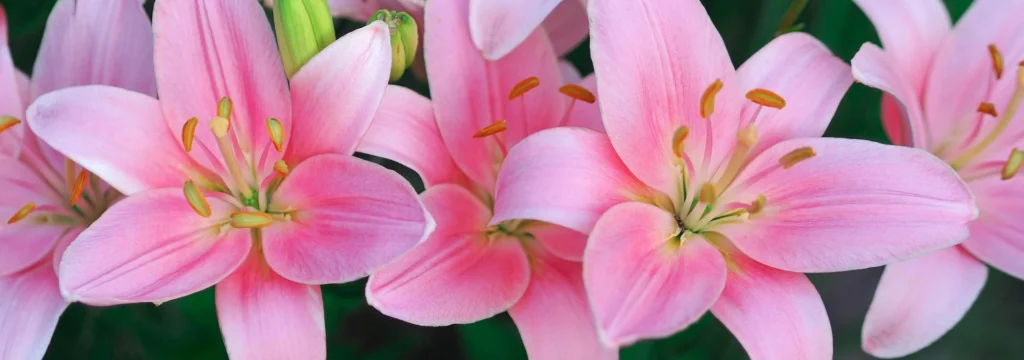
Lilies are among the most striking garden plants. Their elegant, often strongly scented flowers make them a focal point in beds, pots and bouquets. Beyond their visual appeal, lilies also stand for purity, love and dignity. It is no surprise they have been recorded in gardens, churches and works of art for centuries.
Origin and botanical classification
Lilies belong to the family Liliaceae and originate from Europe, Asia and North America. Botanically they are assigned to the genus Lilium, which comprises over 100 species. They grow from bulbs, reach heights between 30 centimetres and over two metres depending on the variety, and bear conspicuous flowers in a wide range of colours and forms.
Popular lily species and groups
There are numerous lily species and hybrids, which can be broadly classified into several main groups:
Asian lilies are particularly robust, low-maintenance and available in many vivid colours. They have little scent but are valued for early flowering and strong stems. Oriental lilies are known for their large, fragrant flowers. They bloom later in the year and prefer a slightly acidic, well-drained soil. Trumpet lilies are notable for their long, narrow flowers, which are often strongly scented and curved outward. Tiger lilies and Turk’s-cap lilies are characterised by strongly recurved petals and a natural appearance. They are especially suitable for naturalistic gardens.
Site and soil requirements
Lilies prefer sunny to partly shaded sites, requiring at least four to five hours of direct sun per day. The soil should be humus-rich, nutrient-rich and well-drained. Waterlogging must be avoided, as it can lead to bulb or root rot. A slightly acidic to neutral pH is ideal. On heavy soils, adding sand or fine gravel helps improve drainage.
Planting lily bulbs
The best time to plant lilies is autumn or early spring. Bulbs should be planted at roughly twice their height – typically between 10 and 20 centimetres deep. Spacing between plants should be at least 15 centimetres. After planting, firm the soil and water thoroughly. A mulch layer of leaf litter or bark humus helps retain moisture and reduce weed growth.
Care and fertilisation
Lilies are relatively low-maintenance but reward good water and nutrient supply with particularly vigorous growth and abundant flowering. During the growing season they should be watered regularly without causing waterlogging. A dressing with organic complete fertilizer in spring and again after flowering supports healthy growth and the development of strong bulbs. After the flowers have faded, remove the wilted blooms to prevent seed formation and direct the energy back into the bulb. Cut back the stems only once they have fully died back and yellowed. Tip: Use the flower fertilizer from ARIES or the fertilizer for lush blooms from ARIES Flower Power.
Lilies in pots
Lilies also do very well in containers, provided the pot is large enough and has good drainage. A layer of expanded clay at the bottom ensures water runoff. Use high-quality potting soil mixed with some sand or lava grit to improve permeability. Potted lilies require especially regular watering during the flowering period and should be fertilized at least once a month.
Propagation of lilies
Lilies are easy to propagate. The division of daughter bulbs, which form around the main bulb over the years, is particularly straightforward. These can be removed in autumn and replanted. Another method is propagation via scales — the outer bulb layers, which form new small bulbs in moist substrate at constant warmth. Some species form bulbils in the leaf axils; these can be collected and planted as well. Sowing from seed is possible but time-consuming, as young plants may take several years to reach their first flowering.
Diseases and pests
Lilies are generally robust but can be affected by certain diseases and pests. The lily beetle is particularly feared — a bright red beetle whose larvae destroy leaves and flowers. Fungal diseases such as Botrytis (gray mold) or lily rust also occur in unfavorable weather. Therefore choose a well-ventilated location and remove infected plant parts immediately.
Lilies as cut flowers
Lilies are excellent as cut flowers. Their magnificent blooms keep in a vase for more than a week and emit a pleasant fragrance. For the vase, cut them when the buds begin to open. Remove the lower leaves that would sit in the water and cut the stems on the diagonal. Because the pollen from the stamens can cause stubborn stains, it is advisable to remove it carefully with tweezers.
Symbolism and meaning
Lilies have a deep-rooted symbolic significance in many cultures. In antiquity they were regarded as flowers of the gods; in Christianity they represent purity and the Virgin Mary. White lilies symbolize innocence, purity and peace and are often used at weddings and funerals. Red lilies stand for passion and love, pink lilies for admiration and tenderness. Yellow lilies can express friendship but also jealousy — therefore they should be chosen with care when given as gifts.
Caution with pets
An important note for pet owners: lilies are extremely toxic to cats. Even the smallest amounts — for example from licking pollen or chewing the leaves — can lead to severe poisoning. In households with cats, lilies should therefore be avoided entirely, both in the garden and in a vase.
Combination with other plants
In the garden lilies combine excellently with other perennials. They look especially attractive with lavender, delphinium, lady’s mantle or ornamental grasses. Their upright flower stems provide structure and height in the bed, while ground-covering plants round off the overall appearance. When combining, pay attention to similar site and soil requirements to achieve optimal results.
Conclusion
Lilies are a true gift for any garden. Their impressive flower shape, often intense fragrance and their symbolic meaning make them a special highlight in the plant world. With a little attention to site selection and care, lilies reward you year after year with a magnificent sea of blooms. Whether in the bed, in a pot or in a vase — lilies bring timeless elegance to every garden and every home.