
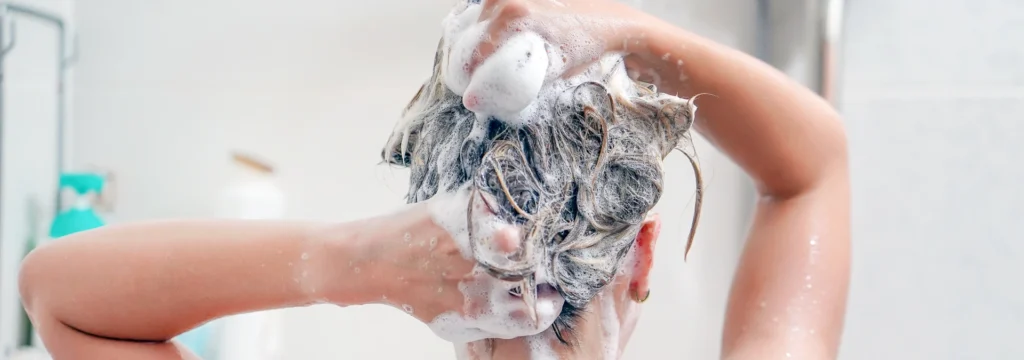
Make your own hair soap – simple, natural, and suited to your hair type
Hair cleansing products are among the care items used as part of a routine. They are used regularly. Precisely for that reason it is important that silicones, microplastics and other harmful substances are not present. If you make your own hair soap, you know exactly what it contains. You have the option to adapt the hair soap to your requirements. Highly sensitive people appreciate this advantage, and everyone benefits when brittle hair is balanced with plant-based lipids or the color of blonde hair is intensified with chamomile. In addition, you protect the environment, because you can simply avoid plastic & co.
Which types of hair cleansing products can you make yourself?
You can make all versions of hair cleansing products yourself. This includes liquid shampoo, solid hair shampoo and hair soap as a solid variant made from oils and lye. If you prepare your own hair cleanser, all options have advantages. Unnecessary packaging is eliminated entirely. You can simply fill your shampoo into reusable bottles. However, take care not to use common food packaging to avoid confusion. That applies especially if small children live in the house. Although your homemade shampoo is free of harmful substances, soap and essential oils are not intended for ingestion.
Additional advantages of solid hair soap include its concentration and transportability: on trips hair soap takes up significantly less space and cannot leak.
Ingredients for two basic versions
You can choose whether to saponify your own hair soap or to work with soap flakes. Making soap is not difficult, but somewhat more time-consuming and should be done with protective measures, since you work with sodium hydroxide (NaOH). NaOH is required for the saponification of the oils. The advantage of making your own soap is that you know exactly which ingredients your soap contains. You can obtain sodium hydroxide from a pharmacy. The white solid dissolves in water with the release of heat. This produces lye. Protective gloves, safety goggles and an apron are mandatory when handling lye. Note that soap must cure for about 4 to 6 weeks.
You can also use bar soap or soap flakes. There is bar soap made from vegetable oils. Soap flakes are also available in conventional or plant-based variants. If you place value on good quality, make sure the vegan soap flakes are based on olive oil.
Making soap yourself
Soap flakes or finely chopped bar soap can be processed immediately. If you make your own soap, proceed as follows. You will need:
Protective equipment:
- Safety goggles (from the hardware store)
- Gloves (household cleaning gloves)
- an old long-sleeved shirt
- long pants
Accessories:
- Scale (preferably a precision scale)
- Bowl for the oil and later the soap mixture
- Measuring jug
- Tall pot for making the lye (heat-resistant)
- Spoons, spatula or a wooden cooking spoon
- Silicone molds
Ingredients:
- 1000 grams coconut fat
- 172.02 grams caustic soda (NaOH) for 6% superfat (162.87 grams NaOH for 11% superfat – very soft soap)
- 550 grams (0.6 liters) cold water
1. Prepare the kitchen and put on protective clothing.
2. Warm the coconut oil slightly.
3. Pour the water into the tall container and place it in the sink.
4. Carefully add the precisely measured amount of caustic soda and stir just as carefully.
5. After 10 minutes you can add the resulting lye solution to the oil. It is important that all solid lye particles are dissolved. For safety you can use a fine-mesh sieve.
6. Begin stirring. At first a soap slurry forms. With continued stirring the consistency changes and becomes progressively firmer, up to a kind of buttercream.
7. This is now poured into the prepared molds.
8. The soap remains in the mold for two days, then it is removed and must cure for 6 to 8 weeks. Afterwards you can process it further into hair soap by making your own organic flakes.
Make your own hair soap – Basic recipe
You can quickly produce your own organic hair soap. To do so, proceed as follows. For a basic recipe you need:
Ingredients for the soap solution:
- 15 grams neutral soap flakes
- 250 milliliters distilled water
Additional ingredients:
- 250 milliliters water
- Additives such as chamomile flowers, lavender, nettle or tea tree oil
1. Bring the 250 milliliters of distilled water to a boil.
2. Dissolve the 15 grams of soap flakes in it. This creates the soap solution as the base of your shampoo, which you then process further. For example:
Naturally lightening hair soap
For this, pour 250 milliliters of boiling water over 50 grams of chamomile flowers. Let the infusion steep for one hour, then strain it through a sieve and mix it with the soap solution.
Strengthening hair soap
Pour 250 milliliters of boiling water over 50 grams of nettle and leave it to steep for one hour. After straining, mix the nettle infusion with the soap solution
Fill your finished shampoo into a glass bottle.
Basic recipe for solid shampoo – quick and easy
You can make solid shampoo without NaOH. For the surfactant use Sodium lauryl sulfoacetate (SLSA), which you can also obtain via your pharmacy. Observe the necessary protective measures. In any case you should wear a mask.
Ingredients:
- 200 grams SLSA
- 200 grams cornstarch
- 90 grams shea butter
Equipment:
- 2 pots for melting the shea butter
- bowl
- molds (made from cut-open juice or milk cartons)
1. Gently melt the 90 grams of shea butter in a water bath. For this you need
a large pot half-filled with water, which you bring to a boil. The
second pot containing the shea butter is placed in the first: the shea butter
melts from the steam.
2. Mix 200 grams SLSA and 200 grams cornstarch in a bowl.
3. Remove the pot with the shea butter from the heat source. Spoon by spoon,
add the SLSA–cornstarch mixture to the shea butter while stirring. Additional ingredients such as
essential oils or crushed herbs are added at this stage.
4. Knead all ingredients thoroughly.
5. Put the mass into molds and let it cool overnight (at least
10 hours).
6. You can remove your solid shampoo.
Solid shampoo or hair soap is best stored dry and cool.
Depending on individual hair structure, various herbal additives are suitable.
Hair soap/solid shampoo for dandruff and excessively oily hair
Lavender is used as a balancing agent against dandruff and mildly oily hair. For this use 50 grams of the crushed flowers of the plant or 15 to 20 drops of lavender essential oil.
Hair soap/solid shampoo against hair loss and to strengthen the hair
Rosemary has a strengthening effect on the hair. Add 10 to 15 drops of rosemary essential oil to the base mixture of SLSA, cornstarch and shea butter.
Using hair soap on the path to cosmetic self-sufficiency
If you make hair soap and shampoo yourself, that opens up many possibilities. You can precisely adjust the ingredients. In addition to shea butter and coconut oil, other oils such as safflower oil are possible. That way you create hair care that exactly meets your needs. It is also ecological and designed for sustainability. Hair soap thus becomes a thoroughly pleasant matter, and the production is enjoyable.
Of course you can also order ready-made hair soaps online from naturhaus.
Image credit: iStock 1157440185 Igor Vershinsky