
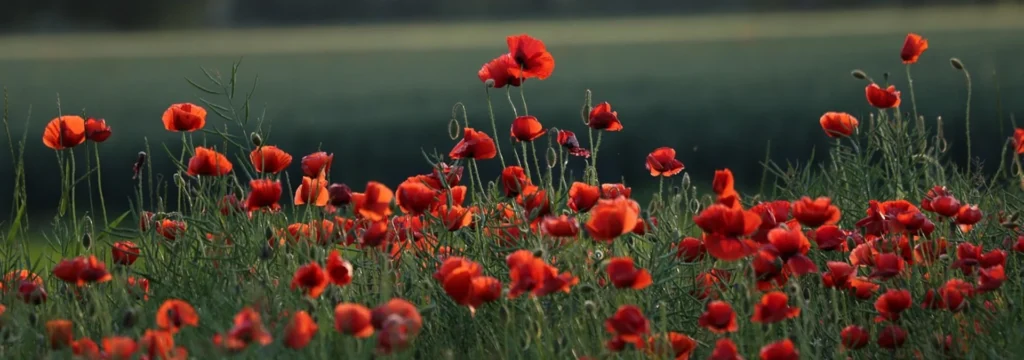
The poppy — also known as the common poppy (Papaver rhoeas) — is one of the most striking and fascinating flowers in domestic gardens and on wild meadows. Its bright red, delicate petals and profound symbolism make it a popular motif in art, literature and garden design. In this comprehensive article you will find everything essential about poppies: origin, care, variety diversity, meaning and tips for cultivating them in your own garden. Ideal for anyone interested in nature, plant care and sustainable garden design.
Origin and history
The poppy has been part of the European cultural landscape for centuries. It originally comes from the Mediterranean region but spread across large parts of Europe and Asia as agriculture expanded. Its appearance in cereal fields was particularly notable, where it once commonly grew between wheat and rye. Today the common poppy is mainly found on fallow land, at field edges and in nature-oriented gardens.
Historically, the poppy played a significant role in folk medicine and symbolism. It was used as a medicinal plant in ancient cultures because some species have mild sedative or analgesic effects. Symbolically, the poppy often represents sleep, death and transience — not least because of the morphine that is obtained from certain poppy species (such as the opium poppy, Papaver somniferum). At the same time, the poppy is also a symbol of peace and hope, particularly since World War I, when it was used as a “Poppy” to commemorate fallen soldiers.
Poppies in the garden: site and soil
Poppies are extremely undemanding regarding location. They prefer sunny sites with sandy to loamy soil. They do not tolerate waterlogging well, so a well-drained site is important. They thrive particularly well in dry, poor soils, where they can fully develop their flower display.
Another advantage of the poppy is its ability to self-seed. Once a plant is established in the garden, new plants often appear the following year without intervention. It is important that the soil is not worked too intensively in autumn or spring so that the fine seeds are not lost.
Poppies: sowing and care
Sowing poppies is ideally done in spring from March or in late autumn directly outdoors. The seeds are very fine and should be pressed down lightly but not covered with soil, as they are light germinators. Within a few weeks the first seedlings appear, and from May to July the poppy blooms in bright red, pink, white or even violet — depending on the variety.
The field poppy is extremely undemanding in terms of care. Regular watering is only necessary in very dry periods. Fertilization can be applied on nutrient-poor soils but is not strictly required. It is important to remove faded plant parts regularly to extend the flowering period. However, those who wish to encourage natural self-seeding should allow some seed capsules to mature.
Popular varieties and species
In addition to the well-known field poppy, there are numerous other species and cultivars that differ in flower color, growth height and flowering time. Particularly popular are:
- Iceland poppy (Papaver nudicaule): This species originates from Arctic regions and produces delicate flowers in yellow, white, orange or pink. It is perennial and well suited to rock gardens or containers.
- Oriental poppy (Papaver orientale): A stately, perennial poppy with large, often deep-red or orange-red flowers. Ideal for perennial beds and sunny borders.
- Opium poppy (Papaver somniferum): Known for its use in opium production, it is also valued as an ornamental. The rounded flowers and decorative seed capsules make it a distinctive eye-catcher in the garden.
- Silky poppy (Papaver rhoeas cultivars): These cultivated forms of the field poppy stand out for their varied color options and larger flowers. They are perfect for flower meadows and naturalistic gardens.
Poppies as bee forage and insect magnet
Poppies make an important contribution to biodiversity in the garden. Their flowers provide abundant pollen for bees, bumblebees and other pollinating insects. Especially at times when many wild plants disappear and monocultures dominate, poppies are a valuable food source and support biodiversity.
Those aiming to design a bee-friendly garden should combine poppies with other native wild plants such as cornflowers, daisies and meadow sage. The result is not only ecologically sensible but also visually appealing.
Poppies as decoration
Although poppies are robust in the garden, they are only of limited suitability as cut flowers. Their delicate blooms wither quickly after cutting. A florist’s trick: briefly singe the stems over a flame — this prevents the milky sap from leaking and extends vase life. Alternatively, the decorative seed capsules can be dried after flowering and used in dried arrangements or for craft projects.
Symbolism and meaning
Poppies have a profound symbolic significance in many cultures. In Greek mythology the poppy was dedicated to the god of sleep, Hypnos. In Christian symbolism it represents transience and eternal sleep. In the modern world the poppy became particularly known through remembrance of the First World War. The poem „In Flanders Fields“ describes poppies growing on the battlefields of Belgium. Since then the „Remembrance Poppy“ has been a powerful symbol of remembrance, peace and admonition.
The poppy is also a popular motif in art—whether in Claude Monet’s famous paintings or as a symbol of summer in poems and songs. The combination of fragile beauty and strong symbolism makes it unique.
Sustainable garden design with poppies
If you want to design your garden sustainably, poppies are a good choice. They require little maintenance, no chemical fertilizers and support native insect life. Poppies are particularly suitable for naturalistic beds, wildflower meadows or in combination with grasses and other native perennials. Through self-seeding they contribute to natural revegetation and are a sign of vibrant ecological diversity.
Conclusion: Poppies are more than just attractive
Whether as a focal point in the garden, a symbol of remembrance and peace, or habitat for bees and butterflies—poppies are genuine all-rounders. Their simple care, striking appearance and ecological importance make them an asset for any gardening enthusiast. Anyone who has experienced the red bloom of a poppy field in summer will never forget that sight. The poppy reminds us how beautiful and at the same time transient nature can be—and why it is worth protecting.