
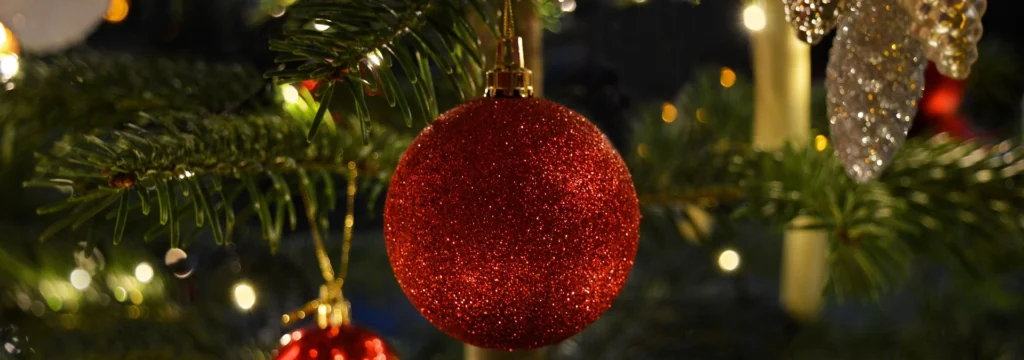
The Christmas tree is a central element of the holiday season. Every year millions of households ask themselves which tree to choose. It is not only a matter of aesthetics and tradition, but also of the environment. Is the Christmas tree still a sustainable choice today? Can one place it in the home without a guilty conscience? In this article we show that the Christmas tree can be an environmentally friendly and tradition-rich element of the holiday season – without harming nature.
1. The history of the Christmas tree
The custom of placing a Christmas tree at Christmas originated in the 16th century. Initially spread primarily in Germany, this custom also found its place in other parts of Europe and later worldwide. The Christmas tree was and remains a symbol of life and hope, since it stays green even during the cold winter months. This symbolism has not lost its significance over the centuries. The way the tree is decorated is constantly changing.
Decorating the tree with lights, baubles and other ornaments is today an important part of Christmas preparations. But the question of its sustainability is increasingly being raised.
2. Sustainability of Christmas trees
Today sustainability is a central concern — also when it comes to the Christmas tree. Many people ask whether buying a real tree is truly the most environmentally friendly choice. It is often assumed that real trees are problematic due to the monocultures in which they are cultivated and the CO2 emissions caused by transport. However, this assumption is not always correct.
A real Christmas tree is a good choice if certain aspects are taken into account. In most cases, Christmas trees come from purpose-built plantations intended for the cultivation of Christmas trees. These plantations provide habitat for animals and promote carbon sequestration, since the trees absorb CO2 from the air during their growth.
Therefore it is important to pay attention to where the tree is purchased to ensure it comes from a sustainable source.
3. The CO2 footprint of the Christmas tree
A common criticism of the real Christmas tree is the CO2 footprint generated by transport. Because trees are often transported over long distances from the plantations to the points of sale, CO2 is of course produced. By comparison, artificial trees made of plastic and metal initially appear to be the more environmentally friendly choice, since they can be used for many years.
However, a closer look shows that the CO2 emissions of a real tree over its lifetime are overall lower than those of an artificial tree. A real tree stores CO2 while it grows, and after its use it can be recycled. Many cities, for example, offer recycling programs in which the trees are composted or used for energy generation.
Artificial trees, by contrast, are made of plastic and other materials that do not break down over years. Even if an artificial tree is used for several years, its production has a larger environmental footprint due to the plastics used and the long transport routes.
4. The advantages of real trees compared to artificial trees
Artificial Christmas trees may at first appear to be a practical alternative to real trees. They can be reused repeatedly and spare buyers the need to purchase a new tree each year. However, the production of artificial trees is far from environmentally friendly. Artificial trees are primarily manufactured in countries such as China, which entails long transport routes and high CO2 emissions.
Furthermore, most artificial trees are made from PVC, a plastic material that is not biodegradable. Even if the tree is used for many years, it remains a problem after its service life because it cannot be recycled. This means that the environmental advantage of artificial trees compared with real trees is not truly convincing.
5. Alternative
A sustainable option for the classic fir tree is the potted fir tree. This is a tree grown in a pot that can be planted out in the garden or placed on the balcony after the holidays. This variant is a particularly environmentally friendly solution, because the tree does not end up in the trash after Christmas but continues to grow.
The potted fir tree is ideal for those seeking a long-term solution and who want to take active steps for the environment. It is also important here to ensure the tree comes from a sustainable source and preferably to choose regional suppliers.
6. The fir tree as part of the Christmas joy
Aside from all ecological considerations, the fir tree remains above all one thing: a symbol of joy, of coming together, and of tradition. The fir is more than just a green element in the living room – it stands for community, for decorating with the family, for singing Christmas carols, and for the celebration of love. These traditional moments are indispensable for many people and are what make the Christmas holiday truly special.
The Christmas tree therefore not only contributes to creating a festive atmosphere, but is also an important component of family and cultural rituals. Thus, the tree can remain a valuable part of the Christmas season not only in ecological terms but also on an emotional level.
7. Conclusion: The Christmas Tree
The Christmas tree can, even in times of climate change, be a sustainable and environmentally friendly symbol of the Christmas season. If one pays attention to the tree’s origin and treats it responsibly, a real Christmas tree is a good choice. A pot-grown tree represents a particularly sustainable option, since it can continue to be used after the holidays.
With the right awareness and the choice of a sustainably produced tree, the Christmas tree can not only bring joy but also be in harmony with nature. In this way the Christmas tree remains a valuable element of the season, combining tradition and environmental awareness.