
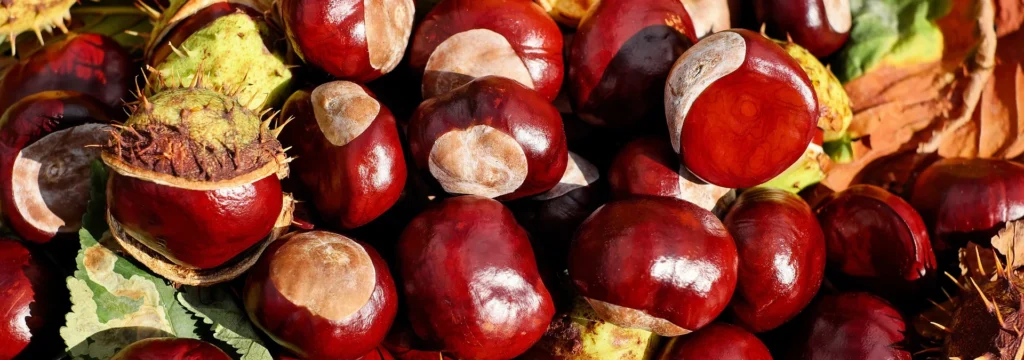
The horse chestnut, scientifically known as Aesculus hippocastanum, is an impressive deciduous tree native to many parts of Europe. With its stately appearance, striking flowers and useful fruits, the horse chestnut holds significance both ecologically and culturally. Here you can learn more about this fascinating tree.
Characteristics of the horse chestnut
The horse chestnut is characterized by the following features:
- Leaves: The leaves are palmately compound and consist of five to seven lanceolate leaflets.
- Flowers: The conspicuous white inflorescences of the horse chestnut appear in late spring and are a common attractant for bees and other pollinating insects.
- Fruits: The horse chestnut’s fruits are spherical, spiny capsules that mature in autumn and contain brown, glossy seeds.
- Growth form: Horse chestnut trees are often large with a broad crown. They can reach heights of up to 30 meters.
Ecological significance
The horse chestnut plays an important role in many ecosystems:
- Food source: The horse chestnut’s flowers provide bees and other pollinators with a rich food resource in spring.
- Wildlife: Squirrels and birds use the horse chestnut’s seeds as a food source.
- Soil improvement: The horse chestnut’s leaves are rich in nutrients and contribute to soil enhancement as they decompose.
Cultural significance
- Parks and avenues: Due to their imposing appearance, horse chestnut trees are often planted in parks and avenues, where they provide shade and aesthetic value.
- Folklore and medicine: In traditional medicine, horse chestnut extracts were historically used to treat venous disorders and hemorrhoids.
- Children’s games: The glossy seeds of the horse chestnut are a popular material for children’s games such as „Kastanienmännchen“ (chestnut figures) or „Kastanienschweinchen“ (chestnut pigs).
Creative craft ideas: autumn DIY projects
Autumn is the perfect season for taking walks outdoors and collecting horse chestnuts. These shiny brown treasures can be wonderfully transformed into a variety of craft projects. Here are some inspiring ideas for how to use horse chestnuts in autumn DIY creations.
1. Chestnut animals
Turn horse chestnuts into charming little animals. With craft materials such as pipe cleaners, googly eyes, paints and glue you can create cute chestnut animals. How about a family of squirrels or playful chestnut beetles? Your imagination has no limits.
2. Chestnut carvings
Try your hand at chestnut carving. With a small carving knife or a nail you can score the chestnut’s shell to create simple patterns or faces. These carved chestnuts can then be used as pendants for necklaces or as decorations for autumn wreaths.
3. Chestnut figures
Chestnut figures are a timeless classic. Use matches or toothpicks to form bodies and arms, and draw small faces on the chestnuts. You can add tiny accessories like hats, scarves and bags. These small figures are not only fun to make but also excellent autumn decorations.
4. Chestnut mobiles
Give your home an autumnal touch by crafting a mobile from chestnuts. Drill holes in the chestnuts and thread them onto thin wire or fishing line. Hang the chestnuts from a wooden ring or a branch and let them drift gently in the wind. The soft clinking of the chestnuts adds a calming atmosphere to your home.
5. Chestnut wreaths
Create autumn door wreaths or table decorations from chestnuts. Use a polystyrene ring or a wire wreath as a base and attach the chestnuts with hot glue. You can leave the chestnuts unpeeled or paint them beforehand to achieve a colorful effect. These handmade wreaths are a great way to put your home in an autumn mood.
Washing laundry with horse chestnuts: an environmentally friendly alternative
Using horse chestnuts as a natural detergent alternative is gaining popularity. Horse chestnuts contain saponins, natural substances that create a soap-like effect during washing. This makes it possible to clean your laundry effectively without resorting to chemical detergents. Learn more about this environmentally friendly method of washing clothes.
How does washing with horse chestnuts work?
The principle is simple: the saponins in horse chestnuts have cleansing properties. They lift dirt and stains from textile fibers, similar to conventional detergents.
- Preparation: Collect ripe horse chestnuts in autumn. They should be firm and free from mold or rot.
- Prepare the detergent: Cut the horse chestnuts into small pieces and remove any shells. Place the pieces in a cloth sachet or a cotton bag.
- Wash cycle: Place the sachet with the horse chestnuts into the washing machine together with your soiled laundry. Select the desired temperature and wash program.
- Drying: After washing you can reuse the horse chestnuts by allowing them to dry. You can use them multiple times until they no longer have a cleansing effect.
Advantages of washing laundry with horse chestnuts
Using horse chestnuts for laundry care offers several advantages:
- Sustainability: Horse chestnuts are a natural resource and biodegradable, making them an environmentally friendly option.
- Hypoallergenic: Because they do not contain harsh chemicals, horse chestnuts are a good choice for people with sensitive skin or allergies.
- Cost savings: Horse chestnuts are often less expensive than commercial detergents and can be used for several wash cycles.
- Odor-neutral: Unlike some detergents, horse chestnuts do not leave artificial fragrances on your clothing.
Important considerations
Although washing with horse chestnuts offers many benefits, there are a few important points to consider:
- Water hardness: In regions with very hard water, the saponins in horse chestnuts may not produce sufficient foaming to clean effectively. In such cases, adding vinegar as a fabric softener or water softener can be helpful.
- Stain treatment: Horse chestnuts alone may not remove stubborn stains as effectively as some conventional stain removers. However, you can try alternative stain removal methods such as baking soda or lemon juice. Alternatively, stubborn stains should be pretreated with gall soap or a stain spray. For white laundry, you should add a bleaching complex (e.g. Sonett Bleichkomplex) to the wash cycle to avoid greying.
Washing with horse chestnuts is an environmentally friendly, cost-effective and hypoallergenic method for cleaning your laundry. It can be a viable alternative to conventional detergents and helps reduce the environmental burden of chemicals. If you are looking for a sustainable way to wash your laundry, you should consider using horse chestnuts.
Conclusion
The horse chestnut is not only an impressive tree in the natural environment but also a culturally significant tree with a wide range of uses. Its contribution to the environment as a food source for pollinators and its ecological benefits make it an important tree species in our ecosystems. Horse chestnuts are not only popular on autumn walks but also in the world of DIY craft projects. Use your creativity and the natural beauty of the chestnuts to create autumnal decorations and small works of art. These craft ideas are not only enjoyable but also give your home a warm autumn atmosphere.