
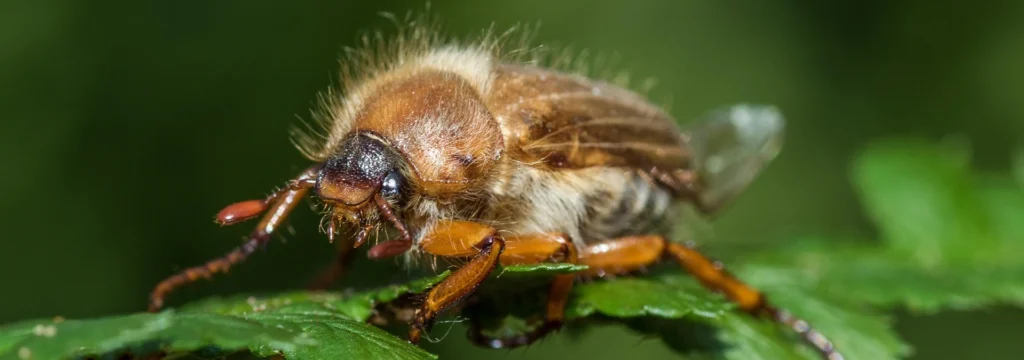
The June beetle (scientific: Amphimallon solstitiale) is among the best-known and at the same time most fascinating beetles in Europe. It appears mainly during the summer months, especially in June, which gave it its name. This article provides a comprehensive overview of the June beetle: its characteristics, life cycle, distribution, role in the ecosystem, and guidance on managing potential damage.
June beetle
The June beetle belongs to the scarab beetle family (Scarabaeidae) and is widespread across much of Europe. It is characterized by a brown, often slightly reddish-tinged body, reaching a length of approximately 15 to 20 millimetres. The elytra are slightly hairy and contribute to its typical appearance.
A typical feature is its slow, somewhat cumbersome flight, observable on warm summer evenings. June beetles are primarily crepuscular and nocturnal, which is why they are rarely seen during the day.
Life cycle and development
The life cycle of the June beetle includes several developmental stages: egg, larva, pupa and adult beetle. Females deposit their eggs in the soil, usually in humus-rich soils or beneath grass cover.
The larvae, also called grubs, spend the majority of their lives underground. There they feed on grass roots and plant roots. Larval development typically lasts three to four years. During this period the grubs can cause significant damage to lawns and agricultural crops in the soil.
After pupation, the adults emerge in late spring or early summer and remain active above ground for several weeks. During this time they are primarily occupied with mating and egg laying.
Distribution and habitat
June beetles are distributed throughout Central Europe, and are particularly common in rural areas, gardens, meadows and fields. They prefer warm and sunny locations with sandy or humus-rich soils that allow good larval development.
The beetle is also adaptable and can survive in various habitats as long as soil conditions are suitable for larval development. Urban green spaces and parks can also serve as habitat.
Role in the ecosystem
Although June beetles are regarded as pests by some gardeners and farmers, they fulfill an important role in the ecosystem. Adult beetles serve as food for various bird species, bats and other insectivores. In addition, their activity contributes to soil aeration.
The larvae, on the other hand, are herbivorous and can cause root damage when they occur in large numbers. Nevertheless, their impact is usually locally limited and part of a natural balance.
Damage caused by June beetles and grubs
Most problems are caused by the larvae of the June beetle. The grubs feed on grass roots and can weaken turf or create bare patches. Damage can also occur in agricultural crops such as cereals, vegetables or ornamental plants.
An infestation usually manifests as yellowing, wilting turf or dead plants. In severe cases, the soil structure can be affected by root feeding, further weakening plant health.
Prevention and Control
Targeted prevention and control of June beetle larvae is particularly advisable in heavily affected gardens and agricultural areas. Environmentally compatible methods should be preferred to avoid disrupting the ecological balance.
Preventive measures:
- Promote healthy, resilient turf through regular maintenance and fertilization.
- Avoid waterlogging and soil compaction.
- Encourage the establishment of natural enemies such as birds and nematodes (roundworms) that parasitize grubs.
Control options:
- Biological agents based on nematodes (Steinernema or Heterorhabditis) that can be applied specifically against grubs.
- Manual collection of larvae in smaller infestation areas.
- Pesticides should only be used as a last resort and with consideration for environmental compatibility.
Interesting facts about the June beetle
- The June beetle is crepuscular and flies mainly in the evening hours.
- The larvae can spend up to four years in the soil before pupating.
- The adult beetles live only a few weeks, primarily for reproduction.
- June beetles have an important ecological role as a food source for many animals.
- The flight sounds of June beetles are characteristic and are often described as buzzing or humming.
Tips for garden owners
Anyone who has June beetles and their larvae in the garden should rely on balanced and sustainable maintenance. Healthy soil and diverse habitats for natural predators help keep populations in balance.
Regular inspection of the lawn and, where necessary, the targeted use of nematodes can minimize damage. Establishing wildflower meadows and hedgerows can also promote biodiversity and support the ecological balance.
Conclusion
The June beetle is a typical harbinger of summer, notable for its appearance and life cycle. Despite occasional damage caused by the larvae, it is an important component of the natural cycle and fulfils various ecological functions. Through targeted maintenance and sustainable measures, potential problems can be minimized so that humans and nature remain in balance.