
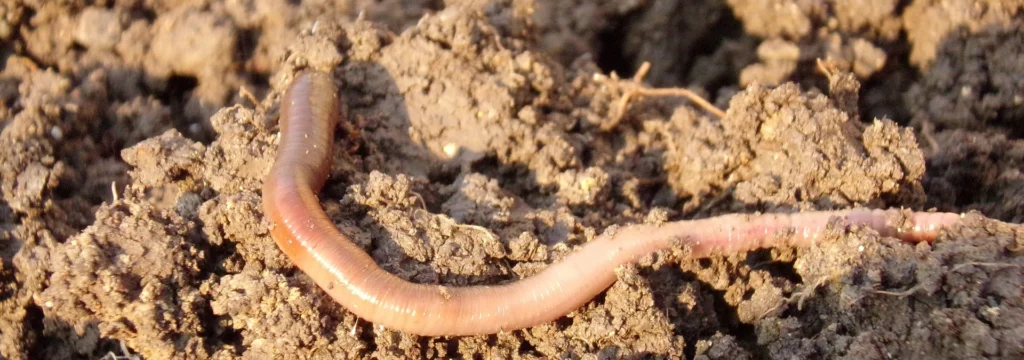
Earthworms are an important component of soil life and contribute to soil health. They burrow through the soil, bringing air and water into deeper layers, which improves aeration and drainage. In addition, their castings create a fertile soil structure by decomposing organic material and releasing essential nutrients.
Species of earthworms
There are over 6,000 different species of earthworms worldwide. In Central Europe, the common earthworm (Lumbricus terRESTris) and the compost worm (Eisenia fetida) are particularly well known. The common earthworm is the largest native species and can reach up to 30 cm in length.
What do earthworms look like?
Earthworms are among the best-known animals in the soil. As already noted, there are over 6,000 different species that can vary in appearance, size and color. In general they have a long, cylindrical body with smooth, moist skin and are colored brown, red or gray. Some species can, however, also be green, blue or yellow.
The body of earthworms is divided into many sections, each encircled by rings called segments. These segments are mobilized by movements of the worm’s longitudinal and circular muscles and enable it to move. They have no eyes but perceive their environment via light receptors located on their skin. They also do not have a mouth in the conventional sense; instead they draw food into their bodies through a muscle called the pharynx. Most earthworms also have a thick, wet mucous layer that helps them move through the soil and retain moisture.
The size of earthworms varies by species and environment. Some species may be only a few millimetres long, while others can reach several metres. Most earthworms that live in our gardens and meadows, however, are about 10–15 cm long. Overall, they are highly adaptable and fascinating animals that make an important contribution to soil health and fertility.
Lifestyle and reproduction
Earthworms live in the soil and feed on dead plant material, bacteria and fungi. They play an important role in soil formation and are responsible for aeration and mixing of the soil. They are hermaphrodites, meaning each individual possesses both male and female reproductive organs. Earthworms mate by rubbing their mucous layers together and exchanging sperm. The eggs are deposited in a cocoon, which can vary in size and shape depending on the species.
Habitat
Earthworms are distributed worldwide and occur in almost all soil types. They prefer moist soils, however, because they rely on a moist skin for respiration. During dry periods they burrow deeper into the soil to avoid desiccation. Depending on the species, earthworms can dig up to 3 meters deep into the soil.
Nutrition
Earthworms are decomposers and feed on dead plant residues and other organic material in the soil. They ingest the material with their mouth and process it in the gut. In the process, bacteria and fungi break down the material and nutrient-rich soil is produced.
Reproduction
Earthworms are hermaphrodites and possess both male and female reproductive organs. Nevertheless, they require a partner to reproduce. During copulation the earthworms exchange packets of sperm, which are stored in the partner’s body. After a few weeks the individual acting as the female then deposits several eggs in its own cocoon, from which juvenile worms hatch after several weeks.
Lifespan
The lifespan of earthworms depends on various factors such as species, habitat and environmental conditions. As a rule, however, they live between 1 and 5 years.
Number of hearts
Earthworms are remarkable animals that are often undeRESTimated. They belong to the group of annelids and live in moist soils. An inteRESTing fact about earthworms is that they actually have multiple hearts. But how many hearts do they have exactly?
Indeed, they have multiple hearts. The number of hearts varies by species, but most earthworms have five hearts.
The hearts are necessary for their movement. The hearts pump blood through the body and keep them alive. Since earthworms have no lungs, they use their skin for respiration. This means that oxygen and carbon dioxide diffuse through the skin.
The hearts of earthworms are also important for their digestion. They help transport nutrients and oxygen through the body. Earthworms ingest food and break it down in the gut. Afterwards the food is absorbed by the organs and pumped into the circulatory system.
Threats from agriculture and environmental pollution
Earthworms are indispensable in their role as soil improvers and soil loosening agents. Nevertheless, they are threatened by the intensification of agriculture and environmental pollution. Pesticides and fertilizers can poison them or disrupt their natural food chain. Increasing soil sealing and the loss of natural habitats are also a danger to earthworms.
Conclusion
Earthworms have a significant impact on the ecosystem. Through their activity they improve soil structure and promote plant growth. They also loosen the soil, which enhances aeration and increases water retention capacity. As a result, plant roots can penetrate deeper into the soil and take up more nutrients. Earthworms are therefore indispensable for a healthy ecosystem and should be protected. Consequently, earthworms are essential helpers in the soil that contribute to soil health and fertility. Through their aeration and drainage they improve the soil climate and create a fertile soil structure. As a threatened species they require protection and deliberate measures in the management of soil and the environment.
More tips and tricks https://www.naturhaus.com/magazin/blog/