
Halloween, celebrated on October 31, is one of the most popular holidays in the USA and has now also gained wide acceptance in many other countries. The custom of dressing up, carving pumpkins and calling „Trick or Treat“ delights people of all ages. But Halloween has a long and fascinating history that reaches back to the time of the Celts. In this text you will learn more about the origins, typical customs and the meaning of today’s Halloween celebration.
1. Origin of Halloween
The origin lies in the ancient Celtic festival Samhain, which was celebrated on November 1. For the Celts, Samhain marked the end of the harvest and the beginning of winter. It was regarded as a night when the boundary between the world of the living and the dead was particularly thin. People believed that spirits and other supernatural beings roamed the night. To protect themselves from these spirits, people dressed in animal skins and masks to deceive the malevolent spirits.
With the spread of Christianity in Europe, Samhain was eventually replaced by the feast of All Saints, which also commemorates the dead and is celebrated on November 1. The word „Halloween“ derives from „All Hallows’ Eve“, meaning the evening before All Saints.
2. Traditions and Customs
Today Halloween is a holiday with many traditions and customs that have developed and spread over time. Some of the best-known customs are:
a) Carving pumpkins
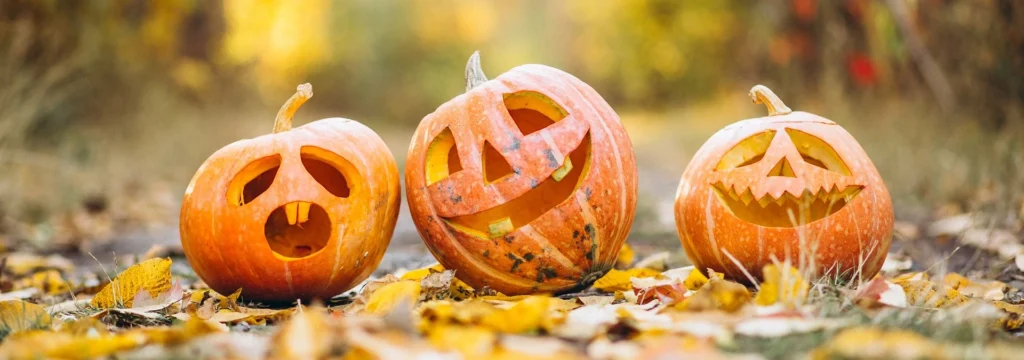
Carving pumpkins, also called „Jack O’Lanterns“, is one of the most popular traditions. The custom goes back to an Irish legend about a man named Jack who tricked the devil and, after his death, was forced to wander the darkness carrying a hollowed-out turnip as a lantern. In America, turnips were replaced by pumpkins because they are easier to work with and are plentiful during the harvest season.
b) Costumes and disguises
Costumes are an essential part of Halloween. People dress as ghosts, witches, vampires or other spooky figures to underscore the eerie atmosphere of the night. Originally people wore disguises to ward off evil spirits or to blend in with them. Today costumes have evolved, and it is also common to dress as superheroes, celebrities or in humorous outfits.
c) Trick or Treat
„Süßes oder Saures“, in English „Trick or Treat“, is a typical tradition in which children go from house to house to collect sweets. In the US this custom has been widespread since the 1920s. Children knock on doors and call out „Süßes oder Saures“ and usually receive sweets. The custom is said to go back to an old superstition that spirits and demons had to be appeased at Halloween to avoid misfortune.
d) Halloween parties
Halloween parties are especially popular in the US and increasingly in Europe. At these events people of all ages gather to dance, watch scary films and admire elaborate costumes. These parties are often decorated with items such as cobwebs, skeletons and jack-o‘-lanterns to create a spooky atmosphere.
e) Ghost stories and horror films
Halloween is also a time when ghost stories are told and horror films are watched. The spooky aspect of the holiday attracts people who enjoy the thrill and the mysterious. Many TV channels and streaming platforms offer dedicated Halloween programming packages with horror films and series.
3. Meaning and evolution of Halloween
Over the centuries Halloween has transformed from a festival intended to ward off evil spirits into a celebration for the whole family. Today Halloween is primarily observed as an entertaining, spooky and family-friendly occasion. Although the festival is still associated with ghosts and supernatural elements, it is less religious and more an occasion for fun and gathering.
In the US Halloween has become a significant economic factor. Costumes, sweets and decorations generate billions in annual revenue. Halloween gives retailers an opportunity to offer specially themed products and to boost sales through special events.
4. Halloween worldwide
While Halloween is most popular in the US, it is gaining popularity in other countries as well:
- Europe: In countries such as the UK and Ireland, where the origins of Halloween lie, the festival has long been celebrated. Parades and festivals often take place, and children also go „Trick or Treat“.
- Germany: Halloween only began to gain popularity in Germany in the 1990s and is becoming increasingly widespread. Especially in large cities there are Halloween parties, and children go through the streets in costume to collect sweets.
- Japan: In Japan Halloween is celebrated as an occasion for costume parties, but without the tradition of „Trick or Treat“. Here Halloween is an opportunity for elaborate costumes and parades, which often represent a spectacle.
5. Halloween and the psychological impact of horror festivities
The fascination with the macabre also has a psychological aspect. Halloween gives people the opportunity to engage with fears and the unknown. Dressing in frightening costumes and entering a gloomy atmosphere can have a therapeutic effect. Halloween allows people to explore their fear while experiencing a sense of control and safety.
Horror events like Halloween also promote a sense of community, as friends and family come together to celebrate. The rituals surrounding Halloween—whether pumpkin carving, telling ghost stories, or watching horror films together—create bonds and strengthen social connections.
Fazit
Halloween is more than just a festival of costumes and sweets – it has a long history rooted in Celtic traditions and offers people of all ages an opportunity to escape everyday life and playfully explore the darker side. Through the customs and rituals associated with Halloween, people experience a sense of community and thrill. Whether in the USA, Europe, or Asia – Halloween is celebrated worldwide and connects people through a shared fascination with the mystical and the supernatural.