
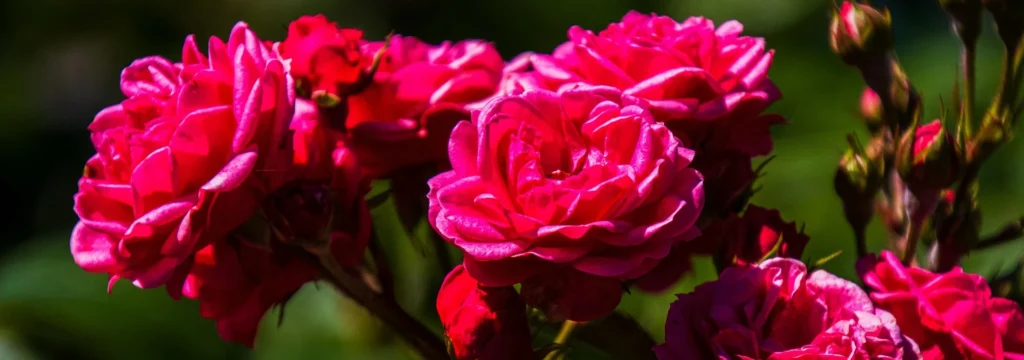
Roses are among the most popular and noble flowers worldwide. They represent love, beauty and elegance — and have been a symbol of appreciation for centuries. But roses are much more than romantic gift flowers. They enrich gardens, balconies and parks with their variety of colors, forms and scents. In this article you will learn everything worth knowing about roses, from popular rose varieties and proper care to symbolic meanings. Whether you want to plant, prune or give roses — here you will find valuable tips and information about the queen of flowers.
What makes the rose so special?
Roses (botanically Rosa) belong to the rose family (Rosaceae) and are distributed worldwide. There are over 30,000 registered varieties that differ greatly in color, growth habit, flowering period and scent. Whether shrub roses, climbing roses or hybrid tea roses — the diversity is almost limitless. Roses impress not only with their aesthetic appearance but also with their symbolic meaning. They are regarded as expressions of love, respect, passion and affection. Therefore roses are an established component of many occasions such as weddings, birthdays or funerals.
Popular rose varieties at a glance
Roses are classified into various categories according to growth habit and use. Here are the best-known types:
Hybrid tea roses
Hybrid tea roses are characterized by their large, full blooms and intense fragrance. They usually grow as individual flowers on long stems and are ideal as cut flowers. Typical for hybrid tea roses is their elegant form and the classic color range from white through pink to deep red.
Bedding roses
Bedding roses are compact and floriferous varieties that are excellent for garden beds and borders. They flower in clusters and are generally very robust. Many modern bedding roses are disease-resistant and require little maintenance.
Climbing roses
Climbing roses grow vigorously upward and are ideal for covering walls, pergolas or fences. They need a support and create an impressive effect with their numerous blooms. Climbing roses are available both as once-flowering and repeat-flowering varieties.
Shrub roses
This type grows wide and bushy and can reach a height of up to two meters. Shrub roses are particularly versatile and add a romantic character to the garden. They are also suitable as specimen plants or as a flowering hedge.
Groundcover roses
These low-growing roses spread out like a carpet and are ideal for ground cover. They are low-maintenance, floriferous and particularly resistant to diseases.
Wild roses
Wild roses are the ancestral forms of today’s cultivated roses. They are particularly robust, frost-hardy and ecologically valuable, as they provide food for numerous insects and birds.
Optimal location
Roses prefer a sunny, well-ventilated location. They require at least four to six hours of sunlight daily to grow healthily and flower profusely. The soil should be deep, humus-rich and well drained. Waterlogging must be avoided, as it can lead to root rot.
The best planting time is in spring or autumn. Container roses can be planted almost year-round, provided the soil is frost-free. It is important that the graft union (the swelling at the lower part of the stem) is positioned about five centimetres below the soil surface.
Care of roses – tips for healthy blooms
Proper maintenance is decisive for healthy, floriferous roses. The following tips support vigorous growth:
1. Watering
Roses require regular water, especially during dry summer months. Water preferably in the morning directly at the root, not over the leaves, to reduce the risk of fungal diseases.
2. Fertilizing
Roses are heavy feeders and need substantial nutrients. Use a dedicated rose fertilizer that is rich in potassium, phosphorus and nitrogen. Apply fertilizer in spring at shoot emergence and a second time in early summer. We recommend ARIES Veganer Dünger or ARIES Universal Gartendünger.
3. Pruning
A targeted rose pruning in spring promotes growth and flowering. Remove dead, diseased and crossing shoots. Bedding roses and hybrid roses are cut back more severely; climbing roses require only a thinning cut.
4. Winter protection
Roses are winter-hardy but require protection from severe cold and frost. Mound soil or mulch around the root area and cover sensitive varieties with fleece or fir branches.
5. Disease prevention
Watch for symptoms such as powdery mildew, rust or black spot. Use biological plant protection products if necessary and ensure adequate air circulation between plants.
Pruning roses – the correct timing
Rose pruning is ideally carried out in early spring, when the forsythia are in bloom. Shoots are cut back to a strong bud. In summer, a light removal of spent flowers is recommended to promote the formation of new buds. Autumn pruning should be restrained to avoid increasing the plants’ susceptibility to frost.
Propagating roses – how to succeed
They can be propagated by cuttings, grafting or layering. The simplest method for hobby gardeners is propagation by cuttings. For this you cut shoots about 15 cm long without flowers in summer and set them into seed/propagation compost. With proper care they will develop their own roots after a few weeks.
Symbolism and meaning
Roses have deep-rooted significance in many cultures. Since antiquity they have been regarded as the flower of love and beauty. Even today, the choice of color plays an important role when giving them as gifts:
- Red roses stand for love, passion and romance
- White roses symbolize innocence, purity and respect
- Yellow roses can express friendship, but also jealousy
- Pink roses stand for gratitude, grace and affection
- Orange roses embody energy and enthusiasm
- Blue roses (usually artificially dyed) are considered a sign of the unattainable
Roses in floristry and cosmetics
Whether as a single bloom or in bouquets – they are indispensable in floristry. They adorn bridal bouquets, arrangements, wreaths and table decorations. Dried rose petals and rose-scented oils are widely used in cosmetics and wellness. We recommend the Bergland Rosen Hautöl or the new Sonett Mistelform Gesichtsöl Rose Lavendel. Roses are also popular as a room fragrance. We recommend the Sodasan Raumduft Rose.
Buying roses – what you should look for
When buying, pay attention to the quality of the plants. Healthy roses have strong shoots, a solid root system and no signs of pest infestation. Prefer varieties described as robust, winter-hardy and disease-resistant – especially if you are a beginner.
Conclusion: Roses are timeless classics with variety and depth
They are more than just attractive flowers – they are an expression of feeling, a highlight in the garden and a symbol of culture and history. Their care requires some attention, but with the right know-how even beginners can enjoy the display of blooms year after year. Whether as a shrub in the garden, a climber on the balcony or as a scent note in the living room: roses captivate and enrich any living space.