
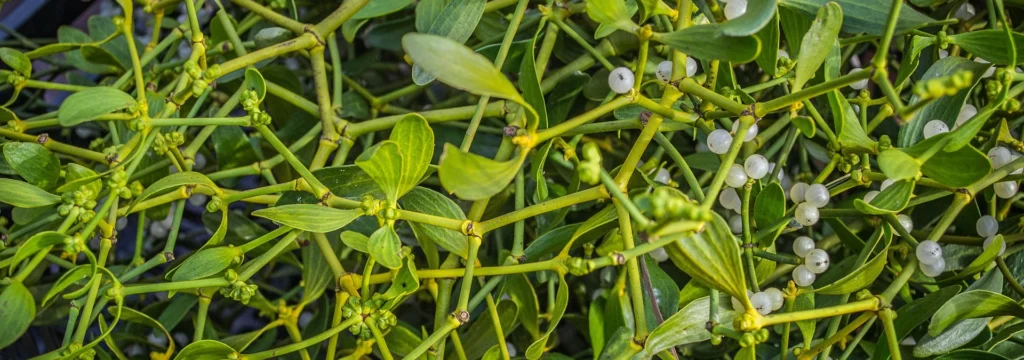
The mistletoe (Viscum album) is a mystical plant that has been used in naturopathy for centuries. Known for its properties and its distinctive growth form, it is primarily found as a hemiparasite on trees. In this text you will learn everything about its history, its uses, and the myths.
1. The mistletoe – botany and growth form
It is an evergreen plant that grows as a hemiparasite on trees. It draws water and nutrients from its host but also conducts photosynthesis itself. Its spherical growth habit and the characteristic white berries make it easy to recognize. It is particularly common on deciduous trees such as apple, linden, and poplar. It prefers temperate climates and is primarily found in Europe, Asia, and North Africa.
2. Historical significance
The mistletoe has been an important medicinal and cult plant in many cultures since antiquity. In Celtic mythology it was considered sacred. Druids harvested it and used it in rituals to heal illnesses or as protection against evil spirits. The mistletoe was also known in ancient Greece and Roman culture. It was regarded as a symbol of fertility and eternal life.
In the modern world the use of the mistletoe has evolved. It is used both in homeopathy and in cosmetics.
3. Applications
Mistletoe extracts are used in a variety of cosmetic products. Here are some examples of how they are applied in skin care:
a) Face creams and serums
Face creams and serums containing mistletoe extracts are suitable for daily skin care. They provide moisture and soothe the skin.
b) Cleansing products
Cleansing milks or cleansing gels with mistletoe extracts are gentle on the skin and can help remove impurities without drying the skin out.
c) Body lotions
Use mistletoe-containing body lotions, for example Sonett Mistelform Bodylotion. They are ideal for dry skin. They provide pleasant hydration.
4. Myths and legends surrounding the mistletoe
As already mentioned, the mistletoe is not only a parasitic plant but is also associated with many myths and traditions. In Celtic mythology it was ascribed magical powers and regarded as a symbol of peace and good fortune. It was customary to stand beneath a sprig of mistletoe and kiss to promote love and fertility – a tradition that has been preserved to this day, especially at Christmas time.
In Norse mythology it also plays a significant role. It was the only plant capable of killing the god Baldur, since it was considered too harmless to be regarded as a weapon. This gave the mistletoe a special status as a powerful but secret force of nature.
5. The origin of the tradition
The custom of kissing beneath a sprig of mistletoe probably goes back to Celtic and Norse legends. In Norse mythology the mistletoe plays an important role in the story of the god Baldur. According to the legend, Baldur was invulnerable to all weapons – except to the mistletoe. The god Loki exploited this weakness and felled Baldur with an arrow made from a mistletoe twig. When the gods eventually reconciled, Baldur’s mother Frigg promised that the mistletoe should henceforth be a symbol of peace.
This myth may be the basis for the mistletoe’s reputation as a symbol of reconciliation and peace. In later centuries, particularly in Victorian England, the tradition of kissing under the mistletoe became popular and has since been a fixed element of Christmas customs.
6. Why the mistletoe sprig is considered a symbol of good fortune
Because of its botanical peculiarities the mistletoe has always aroused fascination. It grows on trees and draws nutrients from them, yet remains green all year round. This resilience made the plant a symbol of immortality and renewal for many cultures. In antiquity the druids revered the mistletoe as sacred and used it in ritual ceremonies to bring blessing and good fortune.
Through these deeply rooted symbols the mistletoe sprig has become a popular emblem intended to bring love, hope and peace at Christmas. Kissing under the mistletoe is therefore not only a romantic ritual but also a way to share the plant’s luck and positive attributes.
7. The custom in different cultures
The custom of kissing under the mistletoe originated in Europe but has since reached many other countries and is celebrated worldwide in various forms:
- United Kingdom and USA: In houses and shops mistletoe is hung, and the tradition of kissing is particularly common at Christmas time. It is a popular custom at Christmas parties and is often seen as a playful way to express affection.
- Germany: In Germany too the mistletoe sprig is increasingly gaining popularity. Although the custom is less established here than in other countries, the mistletoe sprig is increasingly used in Christmas decorations and at festivities.
- France: In France the mistletoe is also a symbol of good luck, traditionally given on New Year’s Eve to bring fortune for the coming year. Here the mistletoe sprig is used not only for romantic purposes but also as a symbol of friendship.
8. Harvesting the mistletoe
Mistletoe grows in the tree canopy, which makes its harvest particularly demanding. The best time to harvest mistletoe is in winter, when the trees have lost their leaves and the mistletoe is easier to spot. Traditionally, mistletoe was taken from trees with special tools or by climbing.
Those who wish to use mistletoe for medicinal purposes should exercise caution. The raw berries of the mistletoe are poisonous and must not be consumed. Only specially prepared mistletoe products, such as those available in pharmacies, can be used safely.
Conclusion
Mistletoe is a fascinating plant with a long tradition and has many facets. Its symbolic significance as a plant of peace and healing remains undisputed, and it will continue to play an important role in naturopathy and in customary practices.
Interesting products:
Sonett Mistelform