
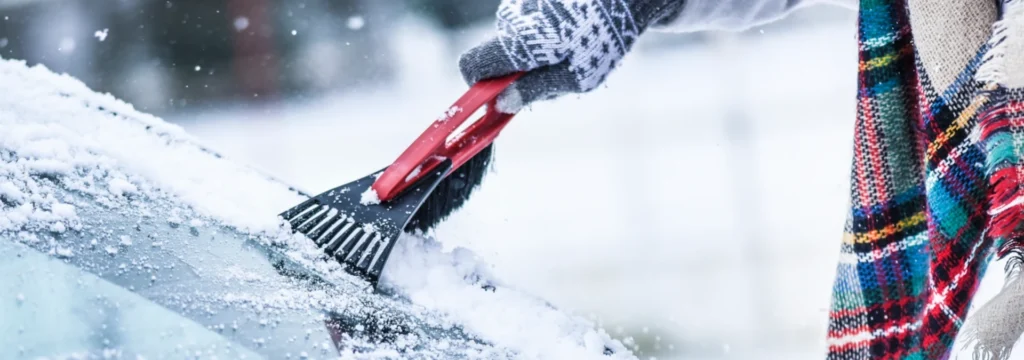
De-icer for car windows — make it yourself easily with only 2 ingredients
When it gradually gets colder outside, temperatures often drop below zero overnight. This brings a common and annoying problem: iced-over windows. If you frequently leave the house in the morning in a hurry for work, school or an important appointment, you will hardly be pleased to find the glass covered with a thin layer of ice crystals. In this case you will of course need a window de-icer the next day.
Most drivers reach for an ice scraper at that moment. It’s quick to hand and relatively effective. At the same time using it even warms you up a little. That is why most drivers who have to leave the house in the morning prefer this practical tool. Unfortunately, scraping damages the glass in the long run. It is much better to use a de-icing agent to ensure clear visibility. That protects the glass and removes the ice without problems.
You can buy de-icer spray, but you can also make it yourself with simple materials. In this article you will learn three easy ways to make de-icing solutions yourself.
Isopropyl alcohol is also generally known as isopropanol, 2-propanol or rubbing alcohol. You can obtain this liquid easily from a pharmacy. It is normally used for disinfectants and in cleaning agents.
De-icing solution from isopropyl alcohol
It is also excellent for making a windshield de-icer for the car windows. Apart from the isopropyl alcohol you only need water and a spray bottle. Mix two parts water with one part isopropyl alcohol and fill this mixture into a spray bottle. For example, you can mix 300 milliliters of isopropyl alcohol with 600 milliliters of water. The de-icer is ready in the practical spray bottle.
Spray this mixture onto the frozen window and wait a moment to let the liquid take effect. After that you can simply remove the ice with a scraper.
You can also use isopropanol for various other purposes: it can serve as a base for disinfectants, glass cleaners or degreasers.
Vinegar-based de-icer
Most households have vinegar on hand. This agent is highly effective against ice. Mix vinegar essence or a regular vinegar of your choice with water. Take a spray bottle and fill it with the mixture. Again, use a ratio of two parts water to one part vinegar.
Spray the homemade de-icer onto the glass and wait one minute before removing the ice with a scraper. Then you’re ready to drive.
Vinegar can also be used in other contexts: vinegar is an effective agent for removing limescale or for cleaning.
Make windshield de-icer from denatured alcohol
The denatured alcohol you still have from summer barbecues can also be used as a windshield de-icer. In addition to the denatured alcohol and water, you will need a little dishwashing liquid. Mix the denatured alcohol with water. Add a few drops of dishwashing liquid and shake the bottle well. This mixture is the finished de-icer and only needs to be applied to the windshield.
Other ways to make de-icer yourself
There are, of course, several other liquids that can serve as the basis for a de-icer. Any high-proof alcohol will work, such as vodka, a high-proof spirit, or Franzbranntwein. Windshield washer antifreeze can also be used as a quick de-icing agent.
Purchase de-icer
It is also possible to simply buy a ready-made de-icer at the nearest petrol station. However, this is more expensive than homemade products. In addition, commercially available products contain significantly more chemically active substances that are considered environmentally harmful. The agents described above are much more biodegradable and are therefore better tolerated by the environment.
Substances that should not be used as windshield de-icer
Radiator antifreeze should not be applied. It is highly toxic—to humans and animals—and should not be used here. Moreover, this product attacks vehicle components. Its use can therefore first damage the vehicle and second poison you.
Engine and wheel cleaners are also not recommended for use on glass. Even if they can free the glass from ice, they are so aggressive that they attack the glass itself. Over time they can etch the glass so that it eventually looks like frosted glass, which is not advisable.
Another sometimes-suggested option is to sprinkle road salt on the glass to loosen the ice. The problem with this is that the salt leaves a film on the glass after the meltwater has dried. In addition, the substance is harmful to the paint in the long term and leads to rust blisters.
Hot water or a hairdryer are generally not recommended either. Both methods attempt to thaw the ice quickly by applying heat and lead to the same problem: the glass beneath the ice is put under stress by the sudden heat. Cracks or the shattering of the pane can result. A hairdryer would allow a slower thaw, but it is absolutely ineffective due to the long time required.
Prevent windows from icing with de-icer
All of the mentioned agents can also be used preventively: for this, simply apply a few sprays of the de-icer to the glass you want to protect on the evening before. This will make the glass at least somewhat less likely to ice over.
Another option to prevent frost is to acquire a protective film. This ensures that the glass does not freeze at all.
Conclusion
De-icer has many advantages: it is simple to use and performs as the user expects. Additionally, it can be applied preventively. Unfortunately, the products available at petrol stations are quite expensive. They also place a significant burden on the environment due to the chemical active ingredients they contain. For these two reasons, it is worthwhile to make de-icer yourself. Homemade agents offer several benefits: first, they are cheaper than conventional de-icers. Second, you know exactly what they contain and can therefore prevent toxic components from being present. You can also ensure that you are using an absolutely environmentally compatible product. A homemade de-icer is thus a good and quick way to spare your wallet, your health and the environment.
Many more recipes can be found here.